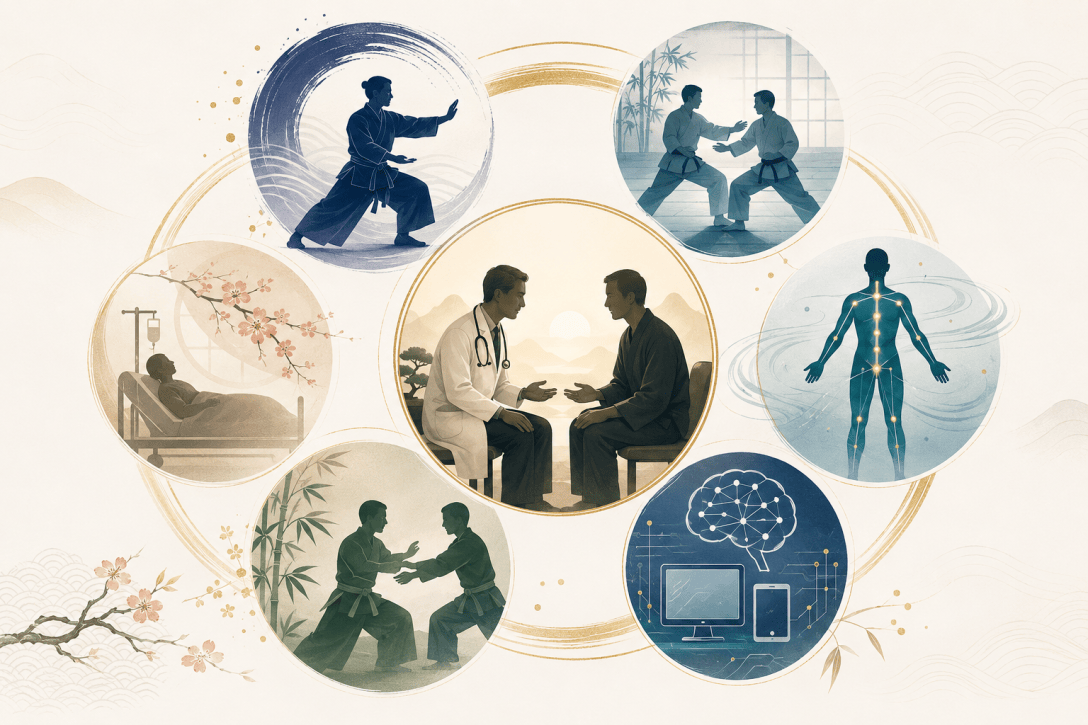
他者との関係の中にある身体―武術から医学を考える

要旨

武術はこれまで主として運動介入として医学研究に取り入れられてきたが、その意義はさらに広い可能性がある。伝統武術には、身体や呼吸の独自の使い方があり、その一部には客観的に測定可能な健康効果があることが報告されている。また、修練者が力で直接対抗することなく相手に応じる形で体を使う、身体的コミュニケーションも含まれる。医学もまた人間関係の相互作用を伴う営みであり、医師―患者関係はより良い医療のために変化してきた一方、医療者が疾患そのものにどのような姿勢で向き合うべきかは、必ずしも明確に定義されていない。伝統武術は、この問題を考える一つの視点を提供しうる。合気道において富木は、合気を、相手の動きに合わせ、力で対抗せずに相手を制御することとして捉えた。疾患を常に克服できるとは限らず、治療自体が患者の負担となりうる慢性疾患では、このような姿勢が臨床的な意味を持つ可能性がある。人工知能(AI)が動作評価や診断を支援するようになっても、身体性と人間関係は医学と武術の双方において根本的な要素であり続けると考えられる。

キーワード:武道;身体性;人間関係

1. はじめに

伝統武術の各体系には、それぞれ固有の身体の動かし方、呼吸法、そして思想がある。その一部は身体が実際にどのように機能するかという原理に基づき、単に戦闘能力を高めるだけでなく、健康や身体機能を最適化することを目的としている(Bu et al., 2010)。太極拳は最もよく研究されている武術であり、姿勢安定性の改善、転倒の減少、心血管機能および身体機能の改善など、多様な健康上の利益との関連が報告されている(Huang et al., 2017; Li et al., 2012; Wang et al., 2016)。

私は長年にわたり、空手をベースとする護身術を実践し、指導してきた。また、内科医として臨床診療と研究にも携わってきた。本稿では、この二つの視点から人間の身体を異なる角度で捉え、医学と武術が交わる領域を考察する。個人的経験への過度な依存による偏りをできる限り避け、医学的背景を持たない読者にも議論を理解し評価してもらえるよう、可能な限りエビデンスに基づいて論を進める。

武術の実践には、医師としての私の仕事に重要な示唆を与えてきた二つの要素がある。第一は呼吸である。意識的に調整された腹式呼吸や横隔膜呼吸は、多くの武術伝統において重要な要素であり、自律神経系、心血管系、心理面に好ましい影響をもたらすことが報告されている(Balban et al., 2023; Hamasaki, 2020; Yau & Loke, 2021; Yeh & Ho, 2024)。武術は戦うために発達した身体運動の体系であり、効果的に実践するためには、自律神経系、とりわけ交感神経活動と副交感神経活動のバランスを調整し、可能であればそのバランスを随意的に変化させる能力も必要となる(Laborde et al., 2022)。呼吸法は、そのための実践的な手段を提供する。

第二の要素は、身体をどのように組織して動かすかである。身体の動かし方は武術の種類や流派によってある程度異なるものの、一般に稽古では、移動中も重心を低く保つこと、左右の四肢を均衡して用いること、手や肩の不要な緊張を避けることが重視される。重心移動、体幹回旋、全身を協調させた運動を重視する太極拳の稽古は、高齢者のバランスおよび歩行制御を改善する(Kim, 2009; Kim et al., 2009)。こうした指導の背景にある生体力学は、リハビリテーション科学においてよく説明されている。体幹の安定性は、四肢を介した力の生成、伝達、制御を支える(Kibler et al., 2006)。運動は、身体各部位の間で力と動きを協調させる運動連鎖(kinetic chain)を通じて構成され、通常は身体の近位部から遠位部へと伝達される。そのため、一つの連鎖部分に機能障害が生じると連鎖全体に影響しうる(Sciascia & Cromwell, 2012)。肩甲骨の安定性も肩複合体の効率的な機能に寄与し、その障害は上肢の運動メカニクスを損なう可能性がある(Paine & Voight, 2013)。注意の向け方も運動の組織化に影響する。一般に、身体内部ではなく外部に注意を向けることで、筋活動や運動学的動作がより効率的になり、より少ない筋活動で同等あるいはそれ以上のパフォーマンスが得られることが多い(Hawkins et al., 2025)。言い換えれば、最適なパフォーマンスは四肢と体幹が統合された一つの全体として機能するときに生じる。私が修練してきた武術では、この身体運動の原理を特に重視している。

日本の古典的な剣術流派においても、呼吸と身体運動の重要性が強調されていた。直心影流の法定の形では、臍下の丹田に心を落ち着け、呼吸を手足の指先まで通し、すべての動きを呼吸と調和させるよう教えられる。打突の際に気勢が過剰になったり、不要な力を用いたりすることは、不適切な動作や姿勢の原因になるとされている(Karukome & Sakai, 2013)。現代医学研究が重心移動や注意の焦点として科学的に測定しているものを、18世紀のある剣術流派では姿勢や不要な力を用いないこととして記述し、それらの原理を実践の中に取り入れていた。先行研究からは、このような身体の使い方が、生活習慣病に対するリハビリテーションや運動療法においても有用である可能性が示唆されている(Bertolini et al., 2025; Wang et al., 2021; Zhang et al., 2024; Zhou et al., 2019)。

武術の実践と医学とのつながりは、運動という側面だけにとどまらない。武術は、他者との身体的コミュニケーションの一形態でもある。実践者は相手を読み、向かってくる攻撃を制御し、自らの身体を守る一方で、自分より身体的に強い相手との直接的な力比べを避ける。医学もまた、異なる手段を用いながら反復的なコミュニケーションを通じて進められるが、医療の対象が常に意図したとおりに反応するとは限らない。二人の人間が出会い、一方がある結果に影響を与えようとし、その後の展開は他方がどのように応じるかによって決まる。武道における形稽古は、単に一人の人間が意識的に身体を動かすことではない。それは、関係性の中で相手と協調して動くことを目指すものである(Uozumi, 2012)。医学も同様に身体性を伴う実践であり、医師は自らの身体を臨床実践の道具として用いている(Kelly et al., 2019)。この構造的な類似性が、本稿の出発点となる。

2. 武術の健康効果

2.1 身体的健康

医学文献における武術の健康効果に関するエビデンスは、主として太極拳に集中しているが、他の武術についても有益な効果が報告されている。以下、代表的な例をいくつか取り上げる。

太極拳は高齢者の転倒を減少させ、機能的移動能力とバランスを改善し、より長期間かつ高頻度の実践で効果が大きい(Chen et al., 2023)。24週間以上の実践は、高齢者および閉経移行期・閉経後女性における腰椎、大腿骨頸部、股関節の骨密度低下も抑制する(Zou et al., 2017)。2型糖尿病患者では、太極拳は空腹時血糖、HbA1c、インスリン抵抗性を低下させるが、その効果は流派や実践期間によって異なる(Zhou et al., 2019; Xia et al., 2019)。24式太極拳と楊式太極拳では空腹時血糖の低下は認められなかった一方、他の様式では3か月を超える稽古後に低下がみられた。したがって、太極拳を単一で均一な介入として扱うことはできず、その効果は具体的な稽古形式に依存すると考えられる。

武術全般を対象としたシステマティックレビューでは、太極拳は他の種目に比べてはるかに多く研究されている一方、柔道、空手、テコンドーの研究は健康アウトカムよりも競技パフォーマンスに主眼を置いていた。合気道、剣道、相撲、弓道については、無作為化試験または対照試験は確認されなかった(Bu et al., 2010)。このように、長い教育的伝統を持つ武術であっても、太極拳以外は健康介入としてほとんど検討されていない。いわゆるハード系武術は、バランス、認知機能、筋骨格系の健康、心理的アウトカム、心肺体力、代謝指標を改善する可能性があるが、小規模標本、便宜的サンプリング、短期間の介入、評価者の盲検化の困難さ、高い脱落率などによりエビデンスには限界がある(Origua Rios et al., 2018)。高齢者では、適応型テコンドーとムエタイの儀礼的舞踊が機能的移動能力を改善した一方、身体活動を行う対照群はバランスと握力でより良好な成績を示した(de Mendonça et al., 2025)。柔道を基盤とするプログラムは、バランス、身体機能、筋力、安全な転倒能力を改善し、より長期のプログラムではQOLと骨密度も改善した(Chan et al., 2023)。安全な転び方を教えることは、武術が医療に提供できる独自の貢献となりうる。テコンドーは運動習慣のない高齢女性の筋量、体力、インスリン抵抗性関連のリスク因子を改善し(Park et al., 2025)、テッキョンは従来の転倒予防運動と比べてバランス、下肢筋力、歩行を改善した(Kim et al., 2024)。空手は高齢者の運動反応性、ストレス耐性、分配性注意を改善し、より長期の稽古によってさらなる向上がみられた(Witte et al., 2016)。著者らは、形が反復運動にはない認知的負荷を伴うことから、未知の動作、技、形を学ぶことがこうした差に寄与した可能性を示唆している。したがって、武術の利益は運動そのものだけでなく、新しいことを学ぶという要素からも生じる可能性がある。

一つの研究は、上述した呼吸と力の発揮を直接結び付けている。訓練された武術実践者は、未訓練の対照者に比べて体重当たりでより大きな力を発揮し、また外力に抗することができ、その際、胃内圧および経横隔膜圧が高く、体幹筋活動が大きく、胃内圧の上昇もより早かった(Walters et al., 2021)。したがって、呼吸、体幹機能、力の発揮は、三つの別々の過程ではなく、一つの機序を構成する要素として理解できる。「丹田に心を落ち着ける」という教えも、異なる概念枠組みの中で同じことを表現していると考えられる。

2.2 精神的健康

Moore et al.(2020)は、武術の稽古によってウェルビーイングが小幅に改善し、内在化型のメンタルヘルス症状が中等度改善することを報告した。一方、攻撃性の有意な低下は認められなかった。この点は注目に値する。武術は攻撃性を低下させると考えられがちであるが、統合されたエビデンスはそのような効果を支持しなかった。武術が単純に攻撃性を低下させるとはいえず、その効果は稽古内容、指導方法、伝統的価値観の重視の程度、競技志向の強さによって異なる(Lafuente et al., 2021)。

日本武道の実践者を対象とした横断研究では、人口統計学的背景を一致させた非実践者と比べて、特性的マインドフルネスと主観的ウェルビーイングが高く、抑うつ症状が少なかった(Miyata et al., 2020)。実践者の中では、実践歴が長いほどマインドフルネスと主観的ウェルビーイングが高く、実践頻度が高いほど抑うつ症状が少なかった。心理的健康状態の良い人ほど武術を始めたり継続したりしやすい可能性もあるため、これらの結果から因果関係を確立することはできない。しかし、長期的な武術実践が心理的安定性の向上に寄与する可能性はある。

精神科病院で武道グループ療法を実施した実行可能性研究では、とくに外来患者で良好な継続率が得られ、高い満足度と意欲、繰り返し参加したいという強い希望、退院後も継続したいという関心が示された(Singh et al., 2024)。この研究の重要性は、有効性を示した点よりも、実施可能性と継続的な参加を示した点にある。身体活動への参加を維持することは精神科医療における大きな課題であり、ここで観察された反復参加は、武道が患者の参加を維持する一つの方法となりうることを示唆している。

2.3 身体的効果を超えて:身体制御から身体化された技能へ

客観的に測定可能な指標を超えて、武術は身体の使い方や制御の仕方にも重要な影響を及ぼす可能性がある。武術で用いられる多くの指導法には、リハビリテーション科学と密接に対応する考え方がみられる。効率的な動作には、身体の各部がばらばらに働くのではなく、統合された一つの全体として機能することが必要である。安定した体幹は、力を生み出し、それを腕や脚へ伝達するための基盤となる(Kibler et al., 2006)。運動連鎖(kinetic chain)とは、動きや力が連結した身体各部を通じて、しばしば脚や体幹から腕へと伝達される仕組みを指す。この連鎖の一部が適切に機能しないと、他の部位が代償しなければならず、動作の効率が低下するとともに、関節への負担が増加する可能性がある(Sciascia & Cromwell, 2012)。肩もその一例である。腕が安定した基盤から動けるようにするためには、肩甲骨が適切な位置に保たれ、効果的に制御されなければならない。肩甲骨の制御が不十分であると、肩の機能が低下し、周囲組織への負担が増加する可能性がある(Paine & Voight, 2013)。多くの武術では、パフォーマンスを向上させるために運動連鎖を最適化するよう実践者に教えている。動作をどのように教えるかも重要である。個々の身体部位ではなく動作がもたらす効果に注意を向ける指示は、一般に、より効率的な動作の組織化を可能にする(Hawkins et al., 2025)。私は、武術訓練の究極的な目標の一つは、体幹から四肢末端に至るまで、身体を真に統合された一つの全体として使うことを学ぶことにあると考えている。

現象学は、人が身体の動かし方を学ぶ際に何が起こるのかを理解するための、もう一つの視点を提供する。日常的な熟練動作において、身体はしばしば意識的な注意の前景から退く。痛みはこの関係を逆転させ、身体を経験の中に強く現れさせることがあり、この現象はdys-appearanceと呼ばれている。一方で、身体は、強さや制御感、あるいは心地よさを感じさせるものとして肯定的に意識されることもあり、これはeu-appearanceと呼ばれている(Zeiler, 2010)。同様の変化は、車椅子操作を学ぶ場合にもみられる。最初は、自分の姿勢や腕、そして車椅子そのものに意識的に注意を向けなければならない。しかし練習を重ねるにつれて、こうした細部に必要な注意は少なくなり、車椅子は世界の中を移動するその人の習慣的な身体の使い方の一部として取り込まれていく(Standal, 2011)。武術の稽古も、これと類似した過程をたどりうる。初心者はしばしば、姿勢、バランス、個々の動作について意識的に考える必要がある。稽古を重ねることで、これらの要素は身体化された技能の一部となり、注意の焦点は身体を制御することから、身体を通して行為することへと移っていく。熟練した武術家は、繰り返し洗練されてきた身体運動のパターンを、ほとんど無意識のうちに遂行することができる。私が実践する武術では、この状態を「無極」と呼ぶ。日本語の「無」は「何もないこと」、「極」は「究極」を意味する。

3. 医師―患者関係

3.1 父権主義から四つのモデルへ

ここまでは、武術を実践する個人の身体に焦点を当てて議論してきた。ここからは、他者との関係、あるいは自らの行為の対象との関係に目を向けたい。医学において、その中心となる相手は患者である。医師―患者関係には、武術における対人稽古と重要な共通点がある。

歴史的に、医師―患者関係は大きく非対称なものであった。医師は、健康を回復させる可能性が最も高いと考えられる介入を選択し、患者の同意を得るために、患者に提供する情報も医師側が管理していた(Kaba & Sooriakumaran, 2007)。

広く用いられている枠組みでは、医師―患者関係は四つのモデルに分類される(Emanuel & Emanuel, 1992)。父権主義的モデルでは、医師は患者の保護者として行動し、患者にとって最善と考えられる選択肢を勧める。情報提供モデルでは、医師が関連する事実を提供し、患者が自らの価値観に基づいて選択する。解釈モデルでは、医師は患者が自らの価値観を明確にし、それを利用可能な選択肢と結び付けることを助ける。熟議モデルでは、どのような健康関連の価値観に基づいて意思決定すべきかを医師と患者が話し合い、医師は部分的に教師あるいは助言者としての役割を果たす。

Emanuel and Emanuel(1992)は、熟議モデルが理想的であると論じている。情報提供モデルでは自律性の捉え方が狭すぎ、医師を単なる技術者へと還元してしまう危険があるためである。彼らの考える自律性とは、単に選択肢の一覧から一つを選ぶことではない。自らの価値観を批判的に吟味し、そのうちどの価値観に基づいて行動すべきかを決め、その決定に従って行動することを意味する。彼らは、医師としての実践の本質を、知識、理解、教育、行為の組み合わせとして捉えている。

また彼らは、これらのモデルが医学だけに限定されるものではないとも指摘している。熟議モデルの要素は、弁護士と依頼人、宗教的指導者と信徒、教育者と学生との関係にも見いだすことができる。道場における師弟関係も、同じような枠組みから理解することができる。

3.2 患者中心性から相互影響へ

患者中心性(patient-centredness)は、20世紀末から21世紀初頭にかけて概念的枠組みが提示され、実証研究との照合が行われた(Mead & Bower, 2000)。父権主義から患者の自律性を尊重する方向への移行は、診療における対話の目的そのものを変化させた(Kilbride & Joffe, 2018)。インフォームド・コンセントでは主として情報開示に重点が置かれ、患者が実際に選択肢を十分理解しているかどうかには、必ずしも同程度の注意が払われてこなかった。共同意思決定(shared decision making)は、この限界に対応するために発展してきた側面がある(Childress & Childress, 2020)。

約30年前には、患者―医師関係について新たなモデルが提唱された(Balint & Shelton, 1996)。その後、関係性中心のケア(relationship-centred care)は、臨床における関係には双方の人格そのものが関与しており、感情や情動もその関係の正当な構成要素であることを強調した(Beach et al., 2006)。Buberの実存哲学も、同様の観点から治癒的関係を理解するために用いられている(Scott et al., 2009)。Balintによる医師―患者関係の研究と、一般開業医とのグループ討議は、診療場面そのものを研究対象として確立するうえで重要な役割を果たした(Lakasing, 2005)。さらに近年では、この視点は「真正性(authenticity)」という概念へと拡張されている。ここでいう真正性とは、単なるコミュニケーション技法ではなく、医師の外面的な行動と内面的な状態との一貫性を意味する(Fuehrer et al., 2024)。

本稿の議論にとって、とりわけ重要な概念が一つある。共同意思決定を可能にする態度や行動について患者と医師に尋ねた研究では、その回答は「相互影響(mutual influence)」という観点から記述された(Lown et al., 2009)。したがって、診療における対話は、一方が他方を教えたり指示したりするだけの過程ではない。双方が互いに影響を与え、また互いから影響を受ける。この相互的な関係は、道場における相手との稽古と密接に対応しており、医学と武術を結び付ける重要な接点となる。

4. 武道:格闘を超えて

4.1 格闘から人格形成へ

武道、すなわち日本の武術は、生存と勝利が差し迫った課題であった実践的な格闘体系として成立した(Abe, 1992; Hurst, 1998)。勝利とは、単に相手より相対的に優れていることを意味したのではない。それは生存そのものと結び付いており、確実に勝利を得るための技法体系が発達した(Abe, 1992)。

近世日本の武術書では、勝敗を超越するという考えが繰り返し論じられている。これを非暴力思想の初期形態と解釈したくなるかもしれないが、歴史的資料はそのような読み方を支持していない。柳生新陰流の伝統では、勝とうとする欲求や負けることへの恐れを手放すことによって、相手の心を読むことが可能になるとされた。示現流の文献でも同様に、疑いや恐怖が介入する前に打つために執着を離れることが説かれている。勝敗の超越そのものを目的とし、それを生死の道を徹底して追究する手段として扱うのは、第三の一群の文献に限られる(Abe, 1992)。したがって、この時代の文献の多くにおいて、勝敗を超越することは、より確実に勝つための手段でもあった。

近世剣術書における精神性を体系的に検討した研究では、芸術的・求道的な精神性と、倫理的・道徳的な精神性とが区別されている。後者について明確に記述した例は、近世を通じてもごく少数に限られる。倫理的あるいは人格的な成長を修行の目的とし、それを武道の本質的特徴とみなす考えは、近代になって成立したと考えられる。これに対し、近世の文献で発達したのは主として前者の精神性であった。「無心」という概念は近世初期に明確化され、中期へと継承された一方、「気」を中心とする理論は中期以降に発展した(Murakami et al., 2016)。

以上は、武術の目的が時代とともに変化してきたと考える歴史的根拠となる。その変化は実際に存在し、しかも比較的新しいものである。

4.2 格闘を超えて、人間関係へ

武術の原理が格闘の領域を超えて応用された例は、過去にも存在する。沢庵宗彭は柳生宗矩との関係を通じて日本武術の精神論に影響を与え、その『不動智神妙録』は宗矩の『兵法家伝書』にも影響を及ぼした(Ohishi, 2013)。この伝承の過程で、武術実践のために発達した心の原理は、政治的統治やより広範な人間関係へと拡張された。本稿において武術の原理を臨床場面へと持ち込もうとする試みも、歴史的な先例を有すると言える。

同様の拡張は、「合気」という概念にもみられる。この語は、特定の技法を指す場合と、精神的な状態を指す場合の両方で用いられてきた。植芝盛平は、大本教および出口王仁三郎の影響を受け、「合気」を次第に調和や愛と結び付けるようになった。1933年の『武道練習』では、真の武道は単に敵を倒すものではなく、相手に対抗しようとする意思を捨てさせ、最終的には調和に資するものでなければならないと論じた。戦後には、愛は争わず、敵を持たないと述べている(Kudo & Shishida, 2010)。

しかし、この解釈が弟子たちの間で一様に共有されていたわけではない。富木謙治は「合気」をより実践的に、相手の動きに自らの動きを適応させ、不必要な対立を避けながらも主導権を維持することとして理解した。富木はまた競技を導入し、安全な試合を行うことで、実践者が自らの力量を評価し、他者との相互作用を通じて自己を修正し、調和の範囲を広げることができると主張した。一方、植芝吉祥丸は競技に反対し、事実上、試合を禁止した(Kudo & Shishida, 2010)。したがって、「戦わない」ということの意味は、武道内部においても議論の対象であり続けた。合気道では、その解釈に違いがあるものの、人間関係における「合気」や精神状態としての「合気」という概念は、医師―患者関係における相互影響(mutual influence)と対応する可能性がある(Lown et al., 2009)。コミュニケーションを通じて、医師と患者は互いに影響を与え合い、治療の成功という共通の目標に向けて意思決定を共同で行う。両者の関係が対立的なものになれば、効果的な治療は困難となる。

武術実践と医学との関係は、日本に固有のものでもない。インド南部のカニヤークマリでは、ヴァルマッカライ(varmakkalai)が身体の急所を、相手を無力化するためにも治療のためにも利用できる部位として捉えている。武術を医学や科学から切り離す近代的な区分は、必ずしもそれらの伝統そのものがどのように構成されていたかを反映しているわけではない(Sieler, 2012)。したがって、本稿で提示する両者の結び付きは、武術と治療実践が時として重なり合ってきた、より広い歴史の一部として位置付けることができる。

4.3 技法から身体化された実践へ

武術の稽古は、実践者が身体を経験し、使用するあり方そのものを変化させることもある。法定の形は直心影流において中心的な位置を占め、その修行体系の第一段階および第二段階で稽古される。第一段階では、勝負を行うことが禁じられている。上達して相手を倒そうとする欲求は修行の妨げとみなされ、過剰な気勢や力任せの打突は誤った動作や姿勢を生み出すとされる(Karukome & Sakai, 2013)。したがって、この文脈における「戦わない」ということは、単なる倫理的理想ではない。勝とうとする欲求が正しい動作の形成を妨げうるため、それは学習のための技術的条件でもある。

これと関連する考え方は、剣道修行についての記述にもみられる。仏教の修行が直接的に心を鍛えることを目的とするのに対し、剣道の稽古は主として技の習得と洗練に向けられている。そして、その過程を通じて精神的修養が形成される。望ましい状態として挙げられるのは、平常心、無心、不動智、明鏡止水などである。勝負においては、止心、驚き、恐れ、疑い、迷い、欲を捨てるよう求められる。心身関係の観点から、Takeda(1982)はその結果を、主体としての身体と客体としての身体との区別が克服され、客体としての身体が完全に主体となる状態として記述している。

現代武道は、この過程について別の表現を提示している。Uozumi(2012)は、武道を、西洋近代スポーツとの接触とそれへの抵抗の双方を通じて19世紀末に形成された身体運動文化として捉えている。「腰」「腹」「丹田」「気」「間合い」といった概念は、近代スポーツで一般に重視されるものとは異なる身体感覚や技術構造を示している。形稽古の目的は、孤立した個人が意識的に制御された動作を単独で遂行することではない。実践者は、関係性の中で他者とともに動くことを学ぶ。Uozumiはこれを、主客二元論と心身二元論の双方を超えて人間を理解する一つの方法として解釈している。

5. 医学:病気を打ち負かすことを超えて

苦痛を和らげることは、古くから医学の中心的な責務の一つであった。しかし、苦痛そのものは、医学教育や医学研究において明示的に扱われてこなかった。苦痛を経験するのは単なる身体ではなく人間そのものであり、それはその人の統合性が脅かされたときに生じる。有能で、かつ患者を真に気遣う医師によって質の高い医療が提供されている場合であっても、治療そのものが病気と並んで苦痛の原因となりうる(Cassel, 1982)。病気を打ち負かすことが医療の唯一の目的になると、その過程で患者の人格や社会的状況が犠牲になる可能性がある。

問題志向型のアプローチは、歴史的には合理的かつ有効であった。しかし現在では、多くの患者や医療者のニーズに十分応えられなくなっている。その限界は、医療者の意欲喪失やバーンアウト、患者の不満や治療不遵守、過剰診断やラベリング、ポリファーマシーや医原性有害事象、望まれない終末期医療、容認し難い医療格差、そして医療費の増大などに表れている。現代医療では、医療者が特定した異常に焦点を当てることから、患者にとって重要な目標へと焦点を移し、患者の役割をより大きくするとともに、より個別化された医療を行うことが求められている(Mold, 2022)。

慢性疾患は現代における主要な健康課題であり、それに対処するために発展してきた治療戦略は、逆説的にも患者の負担を増大させてきた。疾患をコントロールすることを目的とした治療そのものが、アドヒアランスの低下、医療資源の浪費、さらには患者アウトカムの悪化につながることがある。Minimally disruptive medicine(患者負担を最小限にする医療)は、治療計画を患者の日常生活の現実に適合させることを目指す(May et al., 2009)。このモデルはその後、複数の慢性疾患を抱える患者に対する実践的かつ包括的なアプローチへと発展してきた(Leppin et al., 2015)。

利用可能なあらゆる医療資源を用いて病気を打ち負かそうとすることが、必ずしも患者のQOLやウェルビーイングを改善するとは限らない。医学哲学の変化は、武術の目的が歴史的に変化してきた過程と対応する部分があるのかもしれない。状況によっては、病気とあえて戦わないという選択が、患者と医療者の双方により良い結果をもたらす可能性がある。病気を打ち負かすことが医学の第一の目的でなくなれば、医師―患者関係は、現在よりも対等なものになりうる。私自身の経験では、それは、道場でともに稽古し、互いの上達を助け合う実践者同士の関係に近づく可能性がある。この人間関係の問題は、人工知能(AI)の発展によって、さらに重要になる。

6. AIの影響

6.1 AI時代の医師―患者関係

AIが一部の認知的課題において人間の能力を上回るようになるなかで、医師の役割そのものを根本から再考する必要が生じる可能性がある。生成AIはすでに、診断、診療記録の作成、教育、医療情報の提供を支援することができる一方で、その限界やリスクも依然として大きい(Lee et al., 2023)。最近のスコーピングレビューでは、生成AIは効率性を高め、健康情報へのアクセスを拡大し、コミュニケーションの一部を支援する可能性がある一方、臨床医を人間的なケアの提供者ではなく、技術を監督する者へと位置付け直してしまう危険性も指摘されている(Hahne & Carpenter, 2026)。機械が情報提供や認知的支援を人間より効率的に担うようになれば、医師が意味のある役割を維持するためには、単に技術を監督する以上のものが求められる。医師―患者関係そのものを、より明確に協働的なものへと変えていく必要があるかもしれない。患者中心のコミュニケーションではすでに、相互の信頼と理解、意思決定への参加、患者の価値観への配慮、自己管理への支援が重視されている(Hahne & Carpenter, 2026)。Emanuel and Emanuel(1992)も同様に、医師を単に事実を提供する技術者へと還元すべきではないと論じた。彼らが提唱したのは、医師と患者の双方が価値観の理解と行動の選択に積極的に関与する、より熟議的な関係である。この意味で、将来の医師―患者関係は、専門家と受け手という従来の階層的関係よりも、道場でともに稽古する者同士の関係に近づく可能性がある。両者はより対等となり、理解と意思決定の共通の過程に双方が関与する。医師の役割は、単に医学知識を提供することではなく、患者がその知識を理解し、自らの生活の文脈に位置付け、病気とともに生きながらウェルビーイングを追求するための方策を考えることを支援することになる。この考え方は、技術によって臨床実践が変化しても、医学は患者―医師関係を最も根本的な要素として維持すべきだという見解とも一致する(Noseworthy, 2019)。

このような関係には、医師の姿勢そのものの変化も必要である。医師と患者が、知識を一方向に提供する側と受け取る側ではなく、パートナーであるならば、学びは双方向に生じうる。医師は、患者の経験、価値観、そして病気とともに生きることについての患者自身の理解から学ぶ姿勢を持たなければならない。したがって、臨床場面は、患者を治療する機会であるだけでなく、医師自身が学び、成長する機会としても捉えることができる。この機会を認識し、その価値を理解することは、技術的知識だけでは医師の貢献を規定できなくなる時代において、ますます重要な専門的能力となる可能性がある。

6.2 AIと武術実践の未来

AIは武術のさまざまな領域にも応用されつつあり、稽古、競技、教育を変える可能性を持っている。この分野を広く調査した研究では、動作認識、姿勢推定、動作評価、エリート競技者への支援、健康関連への応用、その他の技術的分析などが挙げられている(Pang, Wang, et al., 2025)。空手では、形の動作を認識し、誤りを特定し、その後の練習に向けたフィードバックを提供するコンピュータベースの指導システムが開発されている(Emad et al., 2020)。中国武術に対する機械学習システムでは、人間の専門家に近い精度で動作の質を評価し、教育や学習に利用できる解釈可能なフィードバックを提供できるようになっている(Pang, Zhang, et al., 2025)。テコンドーでは、AIを用いたパフォーマンス分析、動作追跡、バーチャルコーチングが提案されており、より最近のシステムでは、動作分析と拡張現実を統合し、個別化されたフィードバックをリアルタイムで提供している(Shin et al., 2024; Yang & Wang, 2025)。これらの進展は、目に見える動作を観察し、比較し、修正することに依存する武術指導や評価の一部が、今後ますますAIによって支援されうることを示している。

しかし、重要な限界も残されている。武術の動作は高速で複雑かつ三次元的であり、個人差も大きい。姿勢推定システムは、武術特有の通常とは異なる姿勢においてキーポイントを誤認することがあり、二次元座標では三次元的な動作を完全には表現できない。また、速度、リズム、身体的コンディションの違いは、実践者の動作を標準モデルと比較することを難しくする(Pang, Zhang, et al., 2025)。身体の一部が隠れること、複雑な背景、複数の実践者、急速な動作の切り替えなども技術的課題として残っているが、マルチモーダルセンサーや高度化するモデルによって性能は改善しつつある(Sun et al., 2025)。したがって、現在のシステムが表現し評価できるのは、武術動作のうち測定可能な一部の特徴であり、武術実践全体を再現するものではない。

この区別は、本稿の議論にとって特に重要である。武術の稽古は、外から観察できる動作を再現することだけで成り立っているわけではない。前述したように、実践者は身体を統合された一つの全体として組織し、呼吸と動作を協調させ、個々の身体部位を意識的に制御しなくても遂行できる技能を徐々に身につけていく。AIはこうした過程を観察し、その特徴の一部を定量化し、有用な修正フィードバックを与えることさえできるかもしれない。しかしAI自身が、そのような身体化された技能を獲得する身体的過程を経験するわけではない。同じ区別は、前述した健康効果についても当てはまる。AIは呼吸や動作を教えたり監視したりすることはできるが、実践者に代わって稽古を行うことはできない。生理学的・経験的な効果は、人間の身体が実際に反復して行うことから生じる。

それでも、技術の進歩が武術の稽古を変えていくことは確実であり、道場だけが技術的に変化しないと考える理由はほとんどない。より興味深い問いは、技術的分析をますます機械に委ねることができるようになったとき、何がより重要になるのかという点である。もし武術の目的が、勝利や技術的熟練を超えて、自己修養、相互の成長、他者との相互作用を通じた学びを含むのであれば、これらは人と人との関係に依存する。場合によっては、機械のほうが指導者よりも正確に誤った姿勢を特定できるかもしれない。しかし、他者と稽古するということには、別の身体に適応し、相手の意図や限界に応答し、その相互作用を通じて自らも変化することが含まれる。したがって、AI時代において道場は重要性を失うのではなく、むしろより重要になる可能性がある。それは単に技術を伝達する場所としてではなく、人々がともに稽古し、関係を形成し、その関係を通じて身体化された技能と、勝利を超えた武術の目的の双方を育む場所としてである。

7. 結論

本稿では、武術の稽古には独自の身体の使い方が含まれており、それらがリハビリテーションや運動療法に応用できる可能性があることを示してきた。医師―患者関係は歴史とともに変化してきたが、その背景には、医学が目指すアウトカム自体が時代によって変化し、また個々の患者によっても異なることがある。この変化は、武術の目的が変化してきた過程との類比によって理解することができる。武術は、戦うことを超えた目的、すなわち人格形成や、戦わずに生きることを学ぶといった哲学的理念を含むものとして実践されるようになった。

AIの出現と急速な発展は、現在、医学と武術の双方に大きな影響を及ぼしている。両分野は今後も時代とともに変化し続けるだろう。しかし、人と人との関係は残り続ける可能性が高い。医学においては、それは医師と患者の関係である。道場においては、師弟関係や稽古相手同士の関係が含まれる。医師であり武術家でもある私自身の経験から、今後の医師―患者関係は、道場でともに稽古する者同士の関係に、より近づいていく可能性があると考える。それは、双方が互いに影響を与え、それぞれが相手の成長に寄与する相互的な関係である。

医学と武術は、互いから学べることも多いだろう。本稿の範囲を超えるが、国際的に主流の医学体系である西洋医学は、疾患にどのように向き合うべきかを再考する際、東アジアの武術伝統に内在する仏教的思想や非二元論的な考え方から、有用な視点を得られる可能性がある(Nagatomo & Leisman, 1996; Priest, 2013)。一方、武術には、依然として階層的で、ときに権威主義的な師弟関係が強く残っている。そのため武術は、医学がすでに経験してきた権威の再配分、すなわち父権主義からインフォームド・コンセントへ、さらに共同意思決定へと移行してきた過程から学ぶことができるかもしれない(Childress & Childress, 2020)。 AIがどこまで発展し、これらの分野がどれほど変化したとしても、武術に残るのは他者との関係の中に存在する身体であり、医学に残るのは患者との関係の中に存在する身体である。いずれの分野も、孤立した一つの身体だけで完結することはできない。どちらにも必然的に他者との関係が残る。ここに、「戦わない」という理念が特別な意味を持つ。求められるのは対立ではなく、人々が互いに影響を与え、互いから学び、互いの成長を助ける関係なのである。

参考文献

Abe, T. (1992). A study on the value of victory or defeat of budo: From modern kenjutsu densho. Research Journal of Budo, 24(3), 16–25. https://doi.org/10.11214/budo1968.24.3_16

Balban, M. Y., Neri, E., Kogon, M. M., Weed, L., Nouriani, B., Jo, B., Holl, G., Zeitzer, J. M., Spiegel, D., & Huberman, A. D. (2023). Brief structured respiration practices enhance mood and reduce physiological arousal. Cell Reports Medicine, 4(1), 100895. https://doi.org/10.1016/j.xcrm.2022.100895

Balint, J., & Shelton, W. (1996). Regaining the initiative. Forging a new model of the patient-physician relationship. JAMA, 275(11), 887–891. https://doi.org/10.1001/jama.275.11.887

Beach, M. C., Inui, T., & Relationship-Centered Care Research Network. (2006). Relationship-centered care: A constructive reframing. Journal of General Internal Medicine, 21(Suppl 1), S3–S8. https://doi.org/10.1111/j.1525-1497.2006.00302.x

Bertolini, R., Vercelino, R., Ferreira, L. F., & Telles da Rosa, L. H. (2025). Effects of Tai Chi Chuan on older adults’ balance: A systematic review with meta-analysis. Journal of Aging and Physical Activity, 33(1), 84–97. https://doi.org/10.1123/japa.2023-0423

Bu, B., Haijun, H., Yong, L., Chaohui, Z., Xiaoyuan, Y., & Singh, M. F. (2010). Effects of martial arts on health status: A systematic review. Journal of Evidence-Based Medicine, 3(4), 205–219. https://doi.org/10.1111/j.1756-5391.2010.01107.x

Cassel, E. J. (1982). The nature of suffering and the goals of medicine. New England Journal of Medicine, 306(11), 639–645. https://doi.org/10.1056/NEJM198203183061104

Chan, U., Ayliffe, L., Visvanathan, R., Headland, M., Verma, M., & Jadczak, A. D. (2023). Judo-based exercise programs to improve health outcomes in middle-aged and older adults with no judo experience: A scoping review. Geriatrics & Gerontology International, 23(3), 163–178. https://doi.org/10.1111/ggi.14553

Chen, W., Li, M., Li, H., Lin, Y., & Feng, Z. (2023). Tai Chi for fall prevention and balance improvement in older adults: A systematic review and meta-analysis of randomized controlled trials. Frontiers in Public Health, 11, 1236050. https://doi.org/10.3389/fpubh.2023.1236050

Childress, J. F., & Childress, M. D. (2020). What does the evolution from informed consent to shared decision making teach us about authority in health care? AMA Journal of Ethics, 22(5), E423–E429. https://doi.org/10.1001/amajethics.2020.423

de Mendonça, D. L. C., Raider Junior, J. M., da Silva, L. B. B., Alonso, A. C., Greve, J. M. D., & Garcez-Leme, L. E. (2025). Benefits of martial arts on the functional capacity of elderly people: A systematic review and meta-analysis. Clinics, 80, 100830. https://doi.org/10.1016/j.clinsp.2025.100830

Emad, B., Atef, O., Shams, Y., El-Kerdany, A., Shorim, N., Nabil, A., & Atia, A. (2020). iKarate: Karate kata guidance system. Procedia Computer Science, 175, 149–156. https://doi.org/10.1016/j.procs.2020.07.024

Emanuel, E. J., & Emanuel, L. L. (1992). Four models of the physician-patient relationship. JAMA, 267(16), 2221–2226. https://doi.org/10.1001/jama.1992.03480160079038

Fuehrer, S., Weil, A., Osterberg, L. G., Zulman, D. M., Meunier, M. R., & Schwartz, R. (2024). Building authentic connection in the patient-physician relationship. Journal of Primary Care & Community Health, 15, 21501319231225996. https://doi.org/10.1177/21501319231225996

Hahne, J., & Carpenter, B. D. (2026). Patient and clinician engagement with generative artificial intelligence (GenAI): A scoping review of implications for patient-centered communication. Patient Education and Counseling, 145, 109492. https://doi.org/10.1016/j.pec.2026.109492

Hamasaki, H. (2020). Effects of diaphragmatic breathing on health: A narrative review. Medicines, 7(10), 65. https://doi.org/10.3390/medicines7100065

Hawkins, T. E., Alder, D. B., Bennett, T. B., & Poolton, J. M. (2025). The influence of external and internal focus of attention instructions on the organization of movement: A systematic review. Journal of Motor Learning and Development, 13(2), 339–365. https://doi.org/10.1123/jmld.2024-0065

Huang, Z. G., Feng, Y. H., Li, Y. H., & Lv, C. S. (2017). Systematic review and meta-analysis: Tai Chi for preventing falls in older adults. BMJ Open, 7(2), e013661. https://doi.org/10.1136/bmjopen-2016-013661

Hurst, G. C., III. (1998). Armed martial arts of Japan: Swordsmanship and archery. Yale University Press.

Kaba, R., & Sooriakumaran, P. (2007). The evolution of the doctor-patient relationship. International Journal of Surgery, 5(1), 57–65. https://doi.org/10.1016/j.ijsu.2006.01.005

Karukome, Y., & Sakai, T. (2013). An analysis of Hōjō in Jikishinkage-ryū. Research Journal of Physical Arts, 18, 43–57. https://doi.org/10.51078/physicalarts.2013.004

Kelly, M., Ellaway, R., Scherpbier, A., King, N., & Dornan, T. (2019). Body pedagogics: Embodied learning for the health professions. Medical Education, 53(10), 967–977. https://doi.org/10.1111/medu.13916

Kibler, W. B., Press, J., & Sciascia, A. (2006). The role of core stability in athletic function. Sports Medicine, 36(3), 189–198. https://doi.org/10.2165/00007256-200636030-00001

Kilbride, M. K., & Joffe, S. (2018). The new age of patient autonomy: Implications for the patient-physician relationship. JAMA, 320(19), 1973–1974. https://doi.org/10.1001/jama.2018.14382

Kim, C. Y., Jeong, H. W., Baek, C. Y., Kim, S. W., & Kim, H. D. (2024). Effects of Taekkyon-based exercise program on balance, lower extremity strength, and gait parameters in community-dwelling older women: Randomized controlled trial. Medicine, 103(11), e37463. https://doi.org/10.1097/MD.0000000000037463

Kim, H. D. (2009). Effects of Tai Chi exercise on the center of pressure trace during obstacle crossing in older adults who are at a risk of falling. Journal of Physical Therapy Science, 21(1), 49–54. https://doi.org/10.1589/jpts.21.49

Kim, H. D., Han, J. T., & Cho, Y. H. (2009). The effectiveness of community-based Tai Chi training on balance control during stair descent by older adults. Journal of Physical Therapy Science, 21(4), 317–323. https://doi.org/10.1589/jpts.21.317

Kudo, R., & Shishida, F. (2010). The meaning of aiki in Aikido: Focusing on comments made by Morihei Ueshiba and his pupils. Japan Journal of Physical Education, Health and Sport Sciences, 55(2), 453–469. https://doi.org/10.5432/jjpehss.09024

Laborde, S., Allen, M., Borges, U., Dosseville, F., Hosang, T., Iskra, M., Mosley, E., Salvotti, C., Spolverato, L., Zammit, N., & Javelle, F. (2022). Effects of voluntary slow breathing on heart rate and heart rate variability: A systematic review and a meta-analysis. Neuroscience & Biobehavioral Reviews, 138, 104711. https://doi.org/10.1016/j.neubiorev.2022.104711

Lafuente, J. C., Zubiaur, M., & Gutiérrez-García, C. (2021). Effects of martial arts and combat sports training on anger and aggression: A systematic review. Aggression and Violent Behavior, 58, 101611. https://doi.org/10.1016/j.avb.2021.101611

Lakasing, E. (2005). Michael Balint—an outstanding medical life. British Journal of General Practice, 55(518), 724–725.

Lee, P., Bubeck, S., & Petro, J. (2023). Benefits, limits, and risks of GPT-4 as an AI chatbot for medicine. New England Journal of Medicine, 388(13), 1233–1239. https://doi.org/10.1056/NEJMsr2214184

Leppin, A., Montori, V., & Gionfriddo, M. (2015). Minimally disruptive medicine: A pragmatically comprehensive model for delivering care to patients with multiple chronic conditions. Healthcare, 3(1), 50–63. https://doi.org/10.3390/healthcare3010050

Li, F., Harmer, P., Fitzgerald, K., Eckstrom, E., Stock, R., Galver, J., Maddalozzo, G., & Batya, S. S. (2012). Tai chi and postural stability in patients with Parkinson’s disease. New England Journal of Medicine, 366(6), 511–519. https://doi.org/10.1056/NEJMoa1107911

Lown, B. A., Hanson, J. L., & Clark, W. D. (2009). Mutual influence in shared decision making: A collaborative study of patients and physicians. Health Expectations, 12(2), 160–174. https://doi.org/10.1111/j.1369-7625.2008.00525.x

May, C., Montori, V. M., & Mair, F. S. (2009). We need minimally disruptive medicine. BMJ, 339, b2803. https://doi.org/10.1136/bmj.b2803

Mead, N., & Bower, P. (2000). Patient-centredness: A conceptual framework and review of the empirical literature. Social Science & Medicine, 51(7), 1087–1110. https://doi.org/10.1016/s0277-9536(00)00098-8

Miyata, H., Kobayashi, D., Sonoda, A., Motoike, H., & Akatsuka, S. (2020). Mindfulness and psychological health in practitioners of Japanese martial arts: A cross-sectional study. BMC Sports Science, Medicine and Rehabilitation, 12(1), 75. https://doi.org/10.1186/s13102-020-00225-5

Mold, J. W. (2022). Failure of the problem-oriented medical paradigm and a person-centered alternative. The Annals of Family Medicine, 20(2), 145–148. https://doi.org/10.1370/afm.2782

Moore, B., Dudley, D., & Woodcock, S. (2020). The effect of martial arts training on mental health outcomes: A systematic review and meta-analysis. Journal of Bodywork and Movement Therapies, 24(4), 402–412. https://doi.org/10.1016/j.jbmt.2020.06.017

Murakami, R., Sakai, T., Karukome, Y., & Kanzaki, H. (2016). The study on the minds of kenjutsu in the Edo period. Research Journal of Physical Arts, 21, 13–36. https://doi.org/10.51078/physicalarts.2016.002

Nagatomo, S., & Leisman, G. (1996). An east Asian perspective of mind-body. Journal of Medicine and Philosophy, 21(4), 439–466. https://doi.org/10.1093/jmp/21.4.439

Noseworthy, J. (2019). The future of care—Preserving the patient-physician relationship. New England Journal of Medicine, 381(23), 2265–2269. https://doi.org/10.1056/NEJMsr1912662

Ohishi, J. (2013). A study of Zen monk Takuan Sōhō: Researching of his human network and the development of the spiritual theory. Research Journal of Physical Arts, 18, 13–27. https://doi.org/10.51078/physicalarts.2013.002

Origua Rios, S., Marks, J., Estevan, I., & Barnett, L. M. (2018). Health benefits of hard martial arts in adults: A systematic review. Journal of Sports Sciences, 36(14), 1614–1622. https://doi.org/10.1080/02640414.2017.1406297

Paine, R., & Voight, M. L. (2013). The role of the scapula. International Journal of Sports Physical Therapy, 8(5), 617–629.

Pang, Y., Wang, Y., Wang, Q., Li, F., Zhang, C., & Ding, C. (2025). Applications of AI in martial arts: A survey. Proceedings of the Institution of Mechanical Engineers, Part P: Journal of Sports Engineering and Technology, 239(2), 301–331. https://doi.org/10.1177/17543371241273827

Pang, Y., Zhang, K., & Li, F. (2025). Explainable quality assessment of effective aligned skeletal representations for martial arts movements by multi-machine learning decisions. Scientific Reports, 15(1), 323. https://doi.org/10.1038/s41598-024-83475-4

Park, J., Kim, B., Jeong, M., Jung, H. H., Hong, G., & Park, S. K. (2025). Effects of Taekwondo training on thigh muscle cross-sectional area, health-related physical fitness, HbA1c, and GLP-1 in sedentary older women. Frontiers in Sports and Active Living, 7, 1553202. https://doi.org/10.3389/fspor.2025.1553202

Priest, G. (2013). The martial arts and Buddhist philosophy. Royal Institute of Philosophy Supplement, 73, 17–28. https://doi.org/10.1017/S1358246113000246

Sciascia, A., & Cromwell, R. (2012). Kinetic chain rehabilitation: A theoretical framework. Rehabilitation Research and Practice, 2012, 853037. https://doi.org/10.1155/2012/853037

Scott, J. G., Scott, R. G., Miller, W. L., Stange, K. C., & Crabtree, B. F. (2009). Healing relationships and the existential philosophy of Martin Buber. Philosophy, Ethics, and Humanities in Medicine, 4(1), 11. https://doi.org/10.1186/1747-5341-4-11

Shin, M. C., Lee, D. H., Chung, A., & Kang, Y. W. (2024). When Taekwondo meets artificial intelligence: The development of Taekwondo. Applied Sciences, 14(7), 3093. https://doi.org/10.3390/app14073093

Sieler, R. (2012). Kaḷari and vaittiyacālai: Medicine and martial arts intertwined. Asian Medicine, 7(1), 164–195. https://doi.org/10.1163/15734218-12341247

Singh, J., Jawhari, K., Jaffé, M., Imfeld, L., Rabenschlag, F., Moeller, J., Nienaber, A., Lang, U. E., & Huber, C. G. (2024). Implementation of a Budo group therapy for psychiatric in- and outpatients: A feasibility study. Frontiers in Psychiatry, 15, 1338484. https://doi.org/10.3389/fpsyt.2024.1338484

Standal, Ø. F. (2011). Re-embodiment: Incorporation through embodied learning of wheelchair skills. Medicine, Health Care and Philosophy, 14(2), 177–184. https://doi.org/10.1007/s11019-010-9286-8

Sun, Y., Deng, R., & Wei, D. (2025). ST-LineNet: A spatiotemporal network for real-time 3D pose estimation in martial arts training. Alexandria Engineering Journal, 117, 136–147. https://doi.org/10.1016/j.aej.2024.12.097

Takeda, R. (1982). Kendō ni okeru shugyō no seishinteki tokusei ni tsuite [On the spiritual characteristics of shugyō in kendo]. Research Journal of Budo, 15(2), 21–22. https://doi.org/10.11214/budo1968.15.2_21

Uozumi, T. (2012). Considering comparative cultural theory in budo: The possibilities for postmodern human understanding through budo. Research Journal of Budo, 44(3), 121–134. https://doi.org/10.11214/budo.44.121

Walters, S., Hoffman, B., MacAskill, W., Johnson, M. A., Sharpe, G. R., & Mills, D. E. (2021). The control of respiratory pressures and neuromuscular activation to increase force production in trained martial arts practitioners. European Journal of Applied Physiology, 121(12), 3333–3347. https://doi.org/10.1007/s00421-021-04800-7

Wang, L., Ye, M., Xiong, J., Wang, X., Wu, J., & Zheng, G. (2021). Optimal exercise parameters of tai chi for balance performance in older adults: A meta-analysis. Journal of the American Geriatrics Society, 69(7), 2000–2010. https://doi.org/10.1111/jgs.17094

Wang, X., Pi, Y., Chen, P., Liu, Y., Wang, R., Li, X., Chen, B., Zhu, Y., Yang, Y., & Niu, Z. (2016). Traditional Chinese exercise for cardiovascular diseases: Systematic review and meta-analysis of randomized controlled trials. Journal of the American Heart Association, 5(3), e002562. https://doi.org/10.1161/JAHA.115.002562

Witte, K., Kropf, S., Darius, S., Emmermacher, P., & Böckelmann, I. (2016). Comparing the effectiveness of karate and fitness training on cognitive functioning in older adults-a randomized controlled trial. Journal of Sport and Health Science, 5(4), 484–490. https://doi.org/10.1016/j.jshs.2015.09.006

Xia, T. W., Yang, Y., Li, W. H., Tang, Z. H., Li, Z. R., & Qiao, L. J. (2019). Different training durations and styles of tai chi for glucose control in patients with type 2 diabetes: A systematic review and meta-analysis of controlled trials. BMC Complementary and Alternative Medicine, 19(1), 63. https://doi.org/10.1186/s12906-019-2475-y

Yang, F., & Wang, Z. (2025). An intelligent taekwondo coaching system based on augmented reality technology with real-time feedback mechanisms. Scientific Reports, 15(1), 40832. https://doi.org/10.1038/s41598-025-24608-1

Yau, K. K. Y., & Loke, A. Y. (2021). Effects of diaphragmatic deep breathing exercises on prehypertensive or hypertensive adults: A literature review. Complementary Therapies in Clinical Practice, 43, 101315. https://doi.org/10.1016/j.ctcp.2021.101315

Yeh, T. T., & Ho, Y. C. (2024). Immediate effects of structured and natural deep breathing on heart rate variability and blood pressure in community-dwelling older adults. Experimental Gerontology, 198, 112644. https://doi.org/10.1016/j.exger.2024.112644

Zeiler, K. (2010). A phenomenological analysis of bodily self-awareness in the experience of pain and pleasure: On dys-appearance and eu-appearance. Medicine, Health Care and Philosophy, 13(4), 333–342. https://doi.org/10.1007/s11019-010-9237-4

Zhang, W., Wang, H., Xiong, Z., & Li, C. (2024). Efficacy of Tai Chi exercise in patients with hypertension: Systematic review and meta-analysis. Current Problems in Cardiology, 49(11), 102798. https://doi.org/10.1016/j.cpcardiol.2024.102798

Zhou, Z., Zhou, R., Zhu, Y., Li, K., Luo, Y., Zhang, Z., & Luan, R. (2019). Effects of tai chi on physiology, balance and quality of life in patients with type 2 diabetes: A systematic review and meta-analysis. Journal of Rehabilitation Medicine, 51(6), 405–417. https://doi.org/10.2340/16501977-2555

Zou, L., Wang, C., Chen, K., Shu, Y., Chen, X., Luo, L., & Zhao, X. (2017). The effect of Taichi practice on attenuating bone mineral density loss: A systematic review and meta-analysis of randomized controlled trials. International Journal of Environmental Research and Public Health, 14(9), 1000. https://doi.org/10.3390/ijerph14091000

Bodies in Relation: What Martial Arts Can Teach Medicine

ABSTRACT
Martial arts have entered medical research primarily as exercise interventions; however, their relevance may extend further. Traditional martial arts include distinctive ways of using the body and breath, some with measurable health effects, as well as forms of physical communication in which practitioners respond to an opponent without relying on direct force. Medicine likewise involves repeated interaction, and although the physician-patient relationship has evolved to improve care, the stance clinicians should take towards disease itself is less explicitly defined. Traditional martial arts may offer one perspective. In aikido, Tomiki described aiki as matching an opponent’s movement and controlling it without opposing it by force. In chronic illness, where disease cannot always be defeated and treatment itself may impose burdens, such a stance may have clinical relevance. As artificial intelligence increasingly supports movement assessment and diagnosis, embodiment and human relationships are likely to remain fundamental to both medicine and martial arts.

Keywords: budo; embodiment; human relationship

1. Introduction

Traditional martial arts systems each have their own distinctive methods of body movement, breathing techniques, and philosophy. Some of these are built on how the body actually works, and they optimise health or performance rather than only combat (Bu et al., 2010). Tai chi is the best-studied martial art and has been associated with diverse health benefits, including improved postural stability, fewer falls, and better cardiovascular and functional outcomes (Huang et al., 2017; Li et al., 2012; Wang et al., 2016).

I have practised and taught martial arts, specifically a karate-based system of self-defence, for many years. I have also worked in clinical practice and research as a physician in internal medicine. Drawing on these two perspectives, this article views the human body through different lenses and explores the intersection between medicine and martial arts. To minimise bias arising from overreliance on my personal experience, and to allow readers without a medical background to understand and evaluate the arguments, I have grounded the discussion in evidence wherever possible.

Two elements of martial arts practice have provided important insights into my work as a physician. The first is breathing. Controlled abdominal and diaphragmatic breathing is an important component of many martial arts traditions and has been associated with favourable autonomic, cardiovascular and psychological effects (Balban et al., 2023; Hamasaki, 2020; Yau & Loke, 2021; Yeh & Ho, 2024). Martial arts are systems of body movement developed for combat, and effective practice also requires regulation of the autonomic nervous system, particularly the balance between sympathetic and parasympathetic activity and, where possible, the ability to modulate that balance voluntarily (Laborde et al., 2022). Breathing techniques provide a practical means of doing so.

The second element is how the body is organised. Although methods of body movement vary somewhat across martial arts and styles, training generally emphasises keeping the centre of gravity low while moving, using the left and right limbs in a balanced manner, and avoiding unnecessary tension in the hands and shoulders. Tai chi training that emphasises weight shifting, trunk rotation and coordinated whole-body movement improves balance and gait control in older adults (Kim, 2009; Kim et al., 2009). The biomechanics underlying these instructions are well described in rehabilitation science. Trunk stability supports the production, transfer, and control of force through the limbs (Kibler et al., 2006). Movement is organised through kinetic chains in which force and motion are coordinated across body segments, typically from proximal to distal, meaning that dysfunction in one link can affect the entire chain (Sciascia & Cromwell, 2012). Scapular stability likewise contributes to efficient function of the shoulder complex, and its impairment can compromise upper-limb mechanics (Paine & Voight, 2013). Attentional focus also influences movement organisation: an external rather than internal focus generally produces more efficient muscular activation and movement kinematics, often allowing equal or better performance with less muscular activity (Hawkins et al., 2025). In other words, optimal performance emerges when the limbs and trunk function as an integrated whole. The martial art I have trained in places particular emphasis on this principle of body movement.

Japanese classical schools of swordsmanship also emphasised the importance of breathing and body movement. In the Hojo forms of Jikishinkage-ryu, practitioners are taught to settle the mind at the tanden below the navel and to let the breath reach the fingers and toes, with every movement coordinated with breathing. Excessive spirit and unnecessary force during striking are described as causes of incorrect movement and posture (Karukome & Sakai, 2013). What modern medical research measures scientifically as weight shifting and attentional focus was described by an eighteenth-century school of swordsmanship in terms of posture and the absence of unnecessary force, and these principles were incorporated into practice. Previous research suggests that such ways of using the body may also be useful in rehabilitation and exercise therapy for lifestyle-related diseases (Bertolini et al., 2025; Wang et al., 2021; Zhang et al., 2024; Zhou et al., 2019).

The connection between martial arts practice and medicine extends beyond exercise. A martial art is also a form of physical communication with another person. The practitioner reads an opponent, controls an incoming attack, and protects the body while avoiding a direct contest of strength with a physically stronger opponent. Medicine likewise proceeds through repeated communication, using a different set of tools, while the object of medical care does not always respond as intended. Two people meet, one seeks to influence an outcome, and what unfolds depends on how the other responds. Kata training in budo is not simply the conscious movement of an individual. It seeks coordinated movement with a partner within a relationship (Uozumi, 2012). Medicine is likewise an embodied practice in which physicians use their own bodies as instruments of clinical work (Kelly et al., 2019). This structural similarity provides the starting point for this article.

2. Health benefits of martial arts

2.1 Physical health

In the medical literature, evidence for the health benefits of martial arts has focused largely on tai chi, although beneficial effects have also been reported for other martial arts. Several representative examples are considered below.

Tai chi reduces falls and improves functional mobility and balance in older adults, with greater benefits from longer and more frequent practice (Chen et al., 2023). Practice for at least 24 weeks also attenuates bone mineral density loss at the lumbar spine, femoral neck and hip in older adults and peri- and postmenopausal women (Zou et al., 2017). In people with type 2 diabetes, tai chi reduces fasting plasma glucose, glycated haemoglobin and insulin resistance, although effects vary by style and duration (Zhou et al., 2019; Xia et al., 2019). Neither 24-form nor Yang-style tai chi reduced fasting glucose, whereas other styles did after more than three months of practice. Thus, tai chi cannot be treated as a single uniform intervention, and its effects appear to depend on the specific form of practice.

A systematic review across martial arts reported that tai chi had been studied far more extensively than other disciplines, whereas research on judo, karate and taekwondo had focused mainly on athletic performance rather than health outcomes. No randomised or controlled trials were identified for aikido, kendo, sumo or kyudo (Bu et al., 2010). Thus, martial arts with long pedagogical traditions other than tai chi have been examined only rarely as health interventions. Hard martial arts may improve balance, cognition, musculoskeletal health, psychological outcomes, cardiorespiratory fitness and metabolic measures, although the evidence is limited by small samples, convenience sampling, short interventions, difficulty in blinding assessors and high dropout rates (Origua Rios et al., 2018). In older adults, adapted taekwondo and Muay Thai ritual dance improved functional mobility, while physically active controls performed better for balance and handgrip strength (de Mendonça et al., 2025). Judo-based programmes improved balance, physical performance, strength and safe-falling ability, with longer programmes also improving quality of life and bone mineral density (Chan et al., 2023). Teaching safe falling may represent a distinctive contribution of martial arts to healthcare. Taekwondo improved muscle mass, physical fitness and insulin resistance-related risk factors in sedentary older women (Park et al., 2025), while Taekkyon improved balance, lower-extremity strength and gait compared with conventional fall-prevention exercise (Kim et al., 2024). Karate improved motor reactivity, stress tolerance and divided attention in older adults, with further gains after longer training (Witte et al., 2016). The authors suggested that learning unfamiliar movements, techniques and kata contributed to these differences, as kata imposes a cognitive demand that repetitive exercise does not. The benefits of martial arts may therefore arise not solely from exercise itself, but also from having something new to learn.

One study directly links the breathing described above with force production. Trained martial arts practitioners produced and resisted greater force relative to body mass than untrained controls, with higher gastric and transdiaphragmatic pressures, greater trunk muscle activation and earlier increases in gastric pressure (Walters et al., 2021). Breathing, trunk function and force production can therefore be understood as components of a single mechanism rather than as three separate processes. This is also what the instruction to “settle the mind at the tanden” expresses in a different conceptual framework.

2.2 Mental health

Moore et al. (2020) found that martial arts training produced a small improvement in well-being and a moderate improvement in internalising mental health symptoms. No significant reduction in aggression was observed. This finding is worth noting. Martial arts training is often assumed to reduce aggression; however, the pooled evidence did not support such an effect. Martial arts cannot simply be said to reduce aggression; their effects vary depending on the nature of the training, instructional approach, emphasis on traditional values, and degree of competitive orientation (Lafuente et al., 2021).

A cross-sectional study of practitioners of Japanese martial arts found higher dispositional mindfulness and subjective well-being and lower depressive symptoms than in demographically matched non-practitioners (Miyata et al., 2020). Among practitioners, longer practice was associated with greater mindfulness and subjective well-being, while more frequent practice was associated with fewer depressive symptoms. These findings cannot establish causality, since individuals with better psychological health may also be more likely to begin or continue martial arts practice. However, long-term martial arts practice may contribute to greater psychological stability.

A feasibility study implemented Budo group therapy in a psychiatric hospital and found good retention, particularly among outpatients, together with high satisfaction and motivation and strong interest in repeated participation and continuation after discharge (Singh et al., 2024). The importance of this study lies less in demonstrating efficacy than in demonstrating feasibility and sustained engagement. Maintaining participation in physical activity is a major challenge in psychiatric care, and the repeated attendance observed here suggests that budo may offer one way of keeping patients engaged.

2.3 Beyond physical effects: from body control to embodied skill

Beyond objectively measurable parameters, martial arts may also have important effects on how the body is used and controlled. Many instructions used in martial arts have close parallels in rehabilitation science. Efficient movement depends on the body working as an integrated whole rather than as a collection of separate parts. A stable trunk provides a base from which force can be generated and transferred to the arms and legs (Kibler et al., 2006). The kinetic chain describes how movement and force pass through linked body segments, often from the legs and trunk towards the arm. If one part of this chain does not work properly, other parts may have to compensate, making movement less efficient and increasing stress on the joints (Sciascia & Cromwell, 2012). The shoulder provides another example. The shoulder blade must be positioned and controlled effectively to give the arm a stable base for movement. Poor scapular control can reduce shoulder function and increase stress on surrounding tissues (Paine & Voight, 2013). Many martial arts teach practitioners to optimise the kinetic chain to improve performance. How movement is taught also matters. Instructions that direct attention towards the effect of a movement, rather than towards individual body parts, generally allow movement to be organised more efficiently (Hawkins et al., 2025). I argue that one of the ultimate aims of martial arts training is to learn to use the body as a truly integrated whole, from the trunk to the extremities.

Phenomenology offers another way to understand what happens as a person learns to move. In ordinary skilled activity, the body often recedes from conscious attention. Pain can reverse this relationship and make the body intrude on experience, a phenomenon described as dys-appearance. The body can also come to awareness positively, as something that feels strong, controlled or at ease, which has been described as eu-appearance (Zeiler, 2010). A similar change occurs when people learn wheelchair skills. At first, they must consciously attend to their posture, arms and the wheelchair itself. With practice, these details require less attention and the wheelchair can become incorporated into their habitual way of moving through the world (Standal, 2011). Martial arts training can follow a comparable path. Beginners often have to think consciously about posture, balance and individual movements. With practice, these elements can become part of embodied skill, allowing attention to shift from controlling the body to acting through it. Experienced martial artists can perform repeatedly refined patterns of body movement almost unconsciously. In my martial art, this state is called mukyoku. In Japanese, mu means “emptiness” and kyoku means “ultimate”.

3. Physician-patient relationship

3.1 From paternalism and the four models

Thus far, the discussion has focused on the body of the individual who practises martial arts. I would now like to turn to the relationship with another person or with the object of one’s actions. In medicine, the primary person involved is the patient. The physician-patient relationship has important parallels with interpersonal training in martial arts.

Historically, the physician-patient relationship was largely asymmetrical. The physician selected the interventions considered most likely to restore health and controlled the information given to the patient in order to obtain agreement (Kaba & Sooriakumaran, 2007).

A widely used framework distinguishes four models of the physician-patient relationship (Emanuel & Emanuel, 1992). In the paternalistic model, the physician acts as a guardian and recommends what is considered best for the patient. In the informative model, the physician provides the relevant facts and the patient chooses according to their own values. In the interpretive model, the physician helps the patient clarify those values and relate them to available options. In the deliberative model, physician and patient discuss which health-related values should guide the decision, with the physician acting partly as a teacher or adviser.

Emanuel and Emanuel (1992) argue that the deliberative model is the ideal because the informative model offers too narrow a view of autonomy and risks reducing the physician to a technologist. Autonomy, in their account, is not simply choosing an option from a list. It involves critically examining one’s values, deciding which should guide action, and then acting accordingly. They describe the essence of doctoring as a combination of knowledge, understanding, teaching and action.

They also note that these models extend beyond medicine. Elements of the deliberative model can be found in relationships between lawyer and client, religious mentor and follower, and educator and student. The relationship between teacher and student in a dojo can also be understood in this way.

3.2 From patient-centredness to mutual influence

Patient-centredness was given a conceptual framework and examined against the empirical literature at the turn of the century (Mead & Bower, 2000). The move away from paternalism towards respect for patient autonomy changed the purpose of the clinical consultation (Kilbride & Joffe, 2018). Informed consent had focused mainly on disclosure, often with less attention to whether patients truly understood their options. Shared decision making developed in part to address this limitation (Childress & Childress, 2020).

Three decades ago, a new model of the patient-physician relationship was proposed (Balint & Shelton, 1996). Relationship-centred care subsequently emphasised that clinical relationships involve the personhood of both participants and that affect and emotion are legitimate parts of those relationships (Beach et al., 2006). Buber’s existential philosophy has also been used to understand healing relationships in similar terms (Scott et al., 2009). Balint’s work on the doctor-patient relationship and his group discussions with general practitioners helped establish the consultation itself as an object of study (Lakasing, 2005). More recent work has extended this perspective to authenticity, understood as consistency between the physician’s outward behaviour and internal state rather than communication technique alone (Fuehrer et al., 2024).

One concept is particularly important to the argument of this article. When patients and physicians were asked which attitudes and behaviours enable shared decision making, their responses were described in terms of mutual influence (Lown et al., 2009). The consultation is therefore not simply a process in which one person teaches or directs the other. Each participant can influence and be influenced by the other. This reciprocal relationship has a close parallel in training with a partner in a dojo and provides an important point of connection between medicine and martial arts.

4. Budo: beyond combat

4.1 From combat to character formation

Budo, or Japanese martial arts, originated as practical systems of combat in which survival and victory were immediate concerns (Abe, 1992; Hurst, 1998). Victory was not merely a matter of relative superiority over an opponent. It was bound to survival itself, and systems of technique were developed to secure it decisively (Abe, 1992).

Early modern Japanese martial arts texts repeatedly discuss the idea of transcending victory and defeat. It may be tempting to interpret this as an early form of non-violence, yet the historical sources do not support such a reading. In the Yagyu Shinkage-ryu tradition, letting go of the desire to win and the fear of losing enables the practitioner to read the opponent’s mind. Jigen-ryu texts similarly advocate detachment in order to strike before doubt or fear can interfere. Only a third group of texts treats transcendence of victory and defeat as an end in itself, as a means of fully pursuing the way of life and death (Abe, 1992). Thus, in much of the literature of this period, transcending victory and defeat was also a means of winning more reliably.

A systematic examination of spirituality in early modern swordsmanship texts distinguishes artistic and truth-seeking spirituality from ethical and moral spirituality. Clear descriptions of the latter are found in only a few cases across the early modern period. The idea that ethical or character development is the purpose of training and a defining feature of budo appears to have emerged in the modern period. Early modern texts instead developed the former type of spirituality. The concept of mushin, or absence of mind, was articulated in the early period and transmitted into the middle period, while theories centred on ki developed from the middle period onwards (Murakami et al., 2016).

This provides historical grounds for considering the purpose of martial arts to have changed over time. The change is real, and relatively recent.

4.2 Beyond combat and towards human relations

Martial arts principles have been extended beyond combat before. Takuan Soho influenced the spiritual theories of Japanese martial arts through his relationship with Yagyu Munenori, and his Fudochi Shinmyoroku contributed to Munenori’s Heiho Kadensho (Ohishi, 2013). In this transmission, the principles of mind developed for martial arts practice were extended to political governance and human relationships more broadly. The attempt made in this article to carry martial arts principles into the clinical encounter may be said to have a historical precedent.

A similar extension can be seen in the concept of aiki. The term has referred both to particular techniques and to a spiritual state. Morihei Ueshiba, influenced by the Omoto religion and Onisaburo Deguchi, increasingly associated aiki with harmony and love. In Budo Renshu of 1933, he argued that true budo should not merely destroy an enemy, but should lead the opponent to relinquish the will to oppose and should ultimately serve harmony. After the war, he stated that love does not contend and has no enemy (Kudo & Shishida, 2010).

This interpretation was not shared uniformly by his students. Kenji Tomiki understood aiki more practically as adapting one’s movement to that of the opponent, avoiding unnecessary opposition while still retaining control. Tomiki also introduced competition, arguing that safe contests allowed practitioners to assess their own ability, correct themselves through interaction with others, and broaden the sphere of harmony. Kisshomaru Ueshiba opposed competition and effectively prohibited matches (Kudo & Shishida, 2010). The meaning of not fighting remained contested within budo itself. In aikido, despite differences in interpretation, the concept of aiki in interpersonal relationships and as a spiritual state may have parallels with mutual influence in the physician-patient relationship (Lown et al., 2009). Through communication, physicians and patients influence one another and work together in decision making with the shared aim of achieving successful treatment. Once the relationship becomes adversarial, effective treatment becomes difficult.

The relationship between martial arts practice and medicine is also not uniquely Japanese. In Kanyakumari in southern India, varmakkalai treats vital points of the body as sites that can both incapacitate an opponent and be used therapeutically. The modern separation of martial arts from medicine and science does not necessarily reflect the way such traditions themselves were organised (Sieler, 2012). Therefore, the connection proposed here belongs to a broader history in which martial arts and healing practices have sometimes overlapped.

4.3 From technique to embodied practice

Martial arts training can also change the way the practitioner experiences and uses the body. The Hojo forms occupy a central place in Jikishinkage-ryu and are practised in the first and second stages of its curriculum. In the first stage, duelling is prohibited. The desire to advance and defeat opponents is regarded as an obstacle to training, while excessive spirit and forceful striking are said to produce incorrect movement and posture (Karukome & Sakai, 2013). Not fighting is therefore more than an ethical ideal in this context. It is a technical condition of learning because the desire to win can interfere with the formation of correct movement.

A related idea appears in accounts of kendo training. Buddhist ascetic practice aims directly at disciplining the mind, whereas kendo training is directed primarily towards the acquisition and refinement of technique. Mental discipline develops through that process. The states described as desirable include the ordinary mind, absence of mind, immovable wisdom, and the clear mirror and still water. In contest, the practitioner is instructed to abandon the stopping mind, surprise, fear, doubt, confusion and desire. In mind-body terms, Takeda (1982) describes the result as a state in which the distinction between the body as subject and the body as object is overcome, and the body as object becomes fully subject.

Modern budo offers another formulation of this process. Uozumi (2012) describes budo as a movement culture formed at the end of the nineteenth century through both engagement with and resistance to Western modern sport. Concepts such as koshi, hara, tanden, ki and maai refer to bodily sensations and structures of technique that differ from those commonly emphasised in modern sport. In kata practice, the goal is not simply for an isolated individual to execute a consciously controlled movement. The practitioner learns to move with another person within a relationship. Uozumi interprets this as a way of understanding the human being that moves beyond both the subject-object distinction and mind-body dualism.

5. Medicine: beyond defeating disease

The relief of suffering has long been a central obligation of medicine; however, suffering itself has received relatively little explicit attention in medical education and research. Suffering is experienced by persons, not simply by bodies, and arises when the integrity of the person is threatened. Even in high-quality care delivered by competent and genuinely concerned physicians, treatment itself can become a source of suffering alongside the disease (Cassel, 1982). When defeating disease becomes the sole aim of care, the patient’s personhood and social circumstances may be sacrificed in the process.

The problem-oriented approach was historically reasonable and effective. It no longer adequately meets the needs of many patients and clinicians. Its limitations are reflected in clinician demoralisation and burnout, patient dissatisfaction and non-adherence, overdiagnosis and labelling, polypharmacy and iatrogenic harm, unwanted end-of-life interventions, unacceptable disparities, and rising healthcare costs. Contemporary care increasingly calls for a shift in focus from abnormalities identified by clinicians to goals that matter to patients, with a greater role for patients and more individualised care (Mold, 2022).

Chronic disease is a major health challenge of our time, and the treatment strategies developed to manage it have, paradoxically, placed an increasing burden on patients. Treatment intended to control disease can itself contribute to poor adherence, wasted healthcare resources, and worse patient outcomes. Minimally disruptive medicine seeks to fit treatment regimens to the realities of patients’ daily lives (May et al., 2009). This model has since been developed into a practical and comprehensive approach for patients with multiple chronic conditions (Leppin et al., 2015).

Attempting to defeat disease by using every available medical resource does not necessarily improve a patient’s quality of life or well-being. The changing philosophy of medicine may have parallels with the historical transformation in the purpose of martial arts. In some circumstances, choosing not to fight the disease may lead to better outcomes for both patients and clinicians. When defeating disease is no longer the primary aim of medicine, the physician-patient relationship may become more equal than it is today. In my experience, it may come to resemble the relationship between practitioners who train together in a dojo and help one another improve. This issue of human relationships becomes even more important with the development of artificial intelligence (AI).

6. The impact of AI

6.1 The physician-patient relationship in the age of AI

As AI increasingly exceeds human capabilities in some cognitive tasks, the role of the physician may need to be reconsidered from its foundation. Generative AI can already support diagnosis, documentation, education and the provision of medical information, while its limitations and risks remain substantial (Lee et al., 2023). A recent scoping review found that generative AI may improve efficiency, expand access to health information and support some aspects of communication, while also carrying the risk of recasting the clinician as a technical supervisor rather than a humanistic care provider (Hahne & Carpenter, 2026). If machines increasingly provide information and cognitive support more efficiently than humans, preserving a meaningful role for physicians will require more than supervising technology. The physician-patient relationship itself may need to become more explicitly collaborative. Patient-centred communication already emphasises mutual trust, understanding, involvement in decision making, attention to patient values and support for self-management (Hahne & Carpenter, 2026). Emanuel and Emanuel (1992) similarly argued that the physician should not be reduced to a technologist who merely supplies facts. They proposed a more deliberative relationship in which physician and patient actively contribute to understanding values and deciding how to act. In this sense, the future physician-patient relationship may resemble training partners in a dojo more closely than the traditional hierarchy of expert and recipient. The relationship would be more equal, with both participants contributing to a shared process of understanding and decision making. The physician’s task would not simply be to provide medical knowledge, but to help the patient understand that knowledge, place it within the context of their own life, and develop strategies for living with disease while pursuing well-being. This is consistent with the view that medicine should preserve the patient-physician relationship as its most fundamental element even as technology changes clinical practice (Noseworthy, 2019).

Such a relationship also requires a change in the physician’s attitude. If physician and patient are partners rather than one-way providers and recipients of knowledge, learning can occur in both directions. The physician must be prepared to learn from the patient’s experience, values and understanding of life with illness. Clinical encounters may therefore be understood not only as opportunities to treat patients, but also as opportunities for physicians themselves to learn and grow. Recognising and valuing that opportunity may become an increasingly important professional skill in an age when technical knowledge alone no longer defines the physician’s contribution.

6.2 AI and the future of martial arts practice

AI is also increasingly being applied across martial arts and has the potential to change training, competition and education. A broad survey of the field identified applications including action recognition, pose estimation, movement evaluation, support for elite athletes, health-related applications and other forms of technical analysis (Pang, Wang, et al., 2025). In karate, a computer-based guidance system has been developed to recognise movements in kata, identify errors and provide feedback for subsequent practice (Emad et al., 2020). Machine-learning systems for Chinese martial arts can now evaluate movement quality with performance approaching that of human experts and provide interpretable feedback for teaching and learning (Pang, Zhang, et al., 2025). In taekwondo, AI has been proposed for performance analysis, motion tracking and virtual coaching, while more recent systems integrate motion analysis with augmented reality to provide personalised feedback in real time (Shin et al., 2024; Yang & Wang, 2025). These developments suggest that parts of martial arts instruction and assessment that depend on observing, comparing and correcting visible movement can increasingly be supported by AI.

Important limitations remain. Martial arts movements are fast, complex, three-dimensional and highly variable. Pose-estimation systems can misidentify keypoints in unusual martial arts postures, two-dimensional coordinates cannot fully represent three-dimensional movement, and differences in speed, rhythm and physical condition complicate comparisons between a practitioner’s movement and a standard model (Pang, Zhang, et al., 2025). Occlusion, complex backgrounds, multiple practitioners and rapid transitions also remain technical challenges, even as multimodal sensors and increasingly sophisticated models improve performance (Sun et al., 2025). Therefore, current systems represent and evaluate selected measurable features of martial movement rather than reproduce the entirety of martial practice.

This distinction is particularly important for the argument of this article. Martial arts training does not consist solely of reproducing externally observable movements. As discussed above, practitioners learn to organise the body as an integrated whole, coordinate breathing with movement and gradually acquire skills that no longer require conscious control of individual body parts. AI may observe these processes, quantify some of their features and even provide useful corrective feedback. It does not itself undergo the bodily process through which such embodied skill is acquired. The same distinction applies to the potential health effects discussed earlier. An AI system may teach or monitor breathing and movement; however, it cannot perform the practice on behalf of the practitioner. The physiological and experiential effects arise from what the human body repeatedly does.

Advances in technology will nevertheless change martial arts training, and there is little reason to assume that the dojo will remain technically unchanged. The more interesting question may be what becomes more important when technical analysis can increasingly be delegated to machines. If the purpose of martial arts extends beyond winning and technical proficiency to include self-cultivation, mutual development and learning through interaction with others, these aspects depend on relationships between people. A machine may identify an incorrect posture more precisely than an instructor in some circumstances; however, training with another person involves adapting to another body, responding to another person’s intentions and limitations, and being changed through that interaction. Thus, the dojo may become more rather than less important in the age of AI, not simply as a place where techniques are transmitted, but as a place where people practise together and form relationships through which both embodied skill and the purposes of martial arts beyond victory can develop.

7. Conclusions

This article has shown that martial arts training includes distinctive approaches to body use, and that these may have applications in rehabilitation and exercise therapy. The physician-patient relationship has changed over time, partly because the outcomes sought in medicine have also changed across historical periods and differ between individual patients. This transformation can be understood in analogy with changes in the purposes of martial arts. Martial arts came to be practised for aims extending beyond combat, including character development and philosophical ideals such as learning how to live without fighting.

The emergence and rapid development of AI are now exerting major effects on both medicine and martial arts. Both fields continue to change with the times. Human relationships, however, are likely to remain. In medicine, this means the relationship between physician and patient. In the dojo, it includes relationships between teacher and student and between training partners. From my experience as both a physician and a martial artist, I suggest that the physician-patient relationship may increasingly come to resemble that between training partners in a dojo, a relationship characterised by mutual influence in which both participants contribute to the development of the other.

Medicine and martial arts may also have much to learn from one another. Although this lies beyond the scope of the present article, Western medicine, which is the dominant medical tradition internationally, may find useful perspectives in Buddhist and non-dualistic ideas embedded in East Asian martial traditions when reconsidering how disease should be approached (Nagatomo & Leisman, 1996; Priest, 2013). Martial arts, in turn, remain strongly shaped by hierarchical and sometimes authoritarian teacher-student relationships. They may therefore learn from the redistribution of authority that medicine has already undergone, from paternalism to informed consent and subsequently to shared decision making (Childress & Childress, 2020). However far AI develops, and however much these fields change, what remains in martial arts is a body that exists in relation to another person, while what remains in medicine is a body that exists in relation to a patient. Neither field can be completed by an isolated body alone. Both necessarily retain a relationship with another person. It is here that the ideal of not fighting acquires particular significance. What is required is not opposition, but a relationship in which people influence, learn from and help one another to develop.

REFERENCES

Abe, T. (1992). A study on the value of victory or defeat of budo: From modern kenjutsu densho. Research Journal of Budo, 24(3), 16–25. https://doi.org/10.11214/budo1968.24.3_16

Balban, M. Y., Neri, E., Kogon, M. M., Weed, L., Nouriani, B., Jo, B., Holl, G., Zeitzer, J. M., Spiegel, D., & Huberman, A. D. (2023). Brief structured respiration practices enhance mood and reduce physiological arousal. Cell Reports Medicine, 4(1), 100895. https://doi.org/10.1016/j.xcrm.2022.100895

Balint, J., & Shelton, W. (1996). Regaining the initiative. Forging a new model of the patient-physician relationship. JAMA, 275(11), 887–891. https://doi.org/10.1001/jama.275.11.887

Beach, M. C., Inui, T., & Relationship-Centered Care Research Network. (2006). Relationship-centered care: A constructive reframing. Journal of General Internal Medicine, 21(Suppl 1), S3–S8. https://doi.org/10.1111/j.1525-1497.2006.00302.x

Bertolini, R., Vercelino, R., Ferreira, L. F., & Telles da Rosa, L. H. (2025). Effects of Tai Chi Chuan on older adults’ balance: A systematic review with meta-analysis. Journal of Aging and Physical Activity, 33(1), 84–97. https://doi.org/10.1123/japa.2023-0423

Bu, B., Haijun, H., Yong, L., Chaohui, Z., Xiaoyuan, Y., & Singh, M. F. (2010). Effects of martial arts on health status: A systematic review. Journal of Evidence-Based Medicine, 3(4), 205–219. https://doi.org/10.1111/j.1756-5391.2010.01107.x

Cassel, E. J. (1982). The nature of suffering and the goals of medicine. New England Journal of Medicine, 306(11), 639–645. https://doi.org/10.1056/NEJM198203183061104

Chan, U., Ayliffe, L., Visvanathan, R., Headland, M., Verma, M., & Jadczak, A. D. (2023). Judo-based exercise programs to improve health outcomes in middle-aged and older adults with no judo experience: A scoping review. Geriatrics & Gerontology International, 23(3), 163–178. https://doi.org/10.1111/ggi.14553

Chen, W., Li, M., Li, H., Lin, Y., & Feng, Z. (2023). Tai Chi for fall prevention and balance improvement in older adults: A systematic review and meta-analysis of randomized controlled trials. Frontiers in Public Health, 11, 1236050. https://doi.org/10.3389/fpubh.2023.1236050

Childress, J. F., & Childress, M. D. (2020). What does the evolution from informed consent to shared decision making teach us about authority in health care? AMA Journal of Ethics, 22(5), E423–E429. https://doi.org/10.1001/amajethics.2020.423

de Mendonça, D. L. C., Raider Junior, J. M., da Silva, L. B. B., Alonso, A. C., Greve, J. M. D., & Garcez-Leme, L. E. (2025). Benefits of martial arts on the functional capacity of elderly people: A systematic review and meta-analysis. Clinics, 80, 100830. https://doi.org/10.1016/j.clinsp.2025.100830

Emad, B., Atef, O., Shams, Y., El-Kerdany, A., Shorim, N., Nabil, A., & Atia, A. (2020). iKarate: Karate kata guidance system. Procedia Computer Science, 175, 149–156. https://doi.org/10.1016/j.procs.2020.07.024

Emanuel, E. J., & Emanuel, L. L. (1992). Four models of the physician-patient relationship. JAMA, 267(16), 2221–2226. https://doi.org/10.1001/jama.1992.03480160079038

Fuehrer, S., Weil, A., Osterberg, L. G., Zulman, D. M., Meunier, M. R., & Schwartz, R. (2024). Building authentic connection in the patient-physician relationship. Journal of Primary Care & Community Health, 15, 21501319231225996. https://doi.org/10.1177/21501319231225996

Hahne, J., & Carpenter, B. D. (2026). Patient and clinician engagement with generative artificial intelligence (GenAI): A scoping review of implications for patient-centered communication. Patient Education and Counseling, 145, 109492. https://doi.org/10.1016/j.pec.2026.109492

Hamasaki, H. (2020). Effects of diaphragmatic breathing on health: A narrative review. Medicines, 7(10), 65. https://doi.org/10.3390/medicines7100065

Hawkins, T. E., Alder, D. B., Bennett, T. B., & Poolton, J. M. (2025). The influence of external and internal focus of attention instructions on the organization of movement: A systematic review. Journal of Motor Learning and Development, 13(2), 339–365. https://doi.org/10.1123/jmld.2024-0065

Huang, Z. G., Feng, Y. H., Li, Y. H., & Lv, C. S. (2017). Systematic review and meta-analysis: Tai Chi for preventing falls in older adults. BMJ Open, 7(2), e013661. https://doi.org/10.1136/bmjopen-2016-013661

Hurst, G. C., III. (1998). Armed martial arts of Japan: Swordsmanship and archery. Yale University Press.

Kaba, R., & Sooriakumaran, P. (2007). The evolution of the doctor-patient relationship. International Journal of Surgery, 5(1), 57–65. https://doi.org/10.1016/j.ijsu.2006.01.005

Karukome, Y., & Sakai, T. (2013). An analysis of Hōjō in Jikishinkage-ryū. Research Journal of Physical Arts, 18, 43–57. https://doi.org/10.51078/physicalarts.2013.004

Kelly, M., Ellaway, R., Scherpbier, A., King, N., & Dornan, T. (2019). Body pedagogics: Embodied learning for the health professions. Medical Education, 53(10), 967–977. https://doi.org/10.1111/medu.13916

Kibler, W. B., Press, J., & Sciascia, A. (2006). The role of core stability in athletic function. Sports Medicine, 36(3), 189–198. https://doi.org/10.2165/00007256-200636030-00001

Kilbride, M. K., & Joffe, S. (2018). The new age of patient autonomy: Implications for the patient-physician relationship. JAMA, 320(19), 1973–1974. https://doi.org/10.1001/jama.2018.14382

Kim, C. Y., Jeong, H. W., Baek, C. Y., Kim, S. W., & Kim, H. D. (2024). Effects of Taekkyon-based exercise program on balance, lower extremity strength, and gait parameters in community-dwelling older women: Randomized controlled trial. Medicine, 103(11), e37463. https://doi.org/10.1097/MD.0000000000037463

Kim, H. D. (2009). Effects of Tai Chi exercise on the center of pressure trace during obstacle crossing in older adults who are at a risk of falling. Journal of Physical Therapy Science, 21(1), 49–54. https://doi.org/10.1589/jpts.21.49

Kim, H. D., Han, J. T., & Cho, Y. H. (2009). The effectiveness of community-based Tai Chi training on balance control during stair descent by older adults. Journal of Physical Therapy Science, 21(4), 317–323. https://doi.org/10.1589/jpts.21.317

Kudo, R., & Shishida, F. (2010). The meaning of aiki in Aikido: Focusing on comments made by Morihei Ueshiba and his pupils. Japan Journal of Physical Education, Health and Sport Sciences, 55(2), 453–469. https://doi.org/10.5432/jjpehss.09024

Laborde, S., Allen, M., Borges, U., Dosseville, F., Hosang, T., Iskra, M., Mosley, E., Salvotti, C., Spolverato, L., Zammit, N., & Javelle, F. (2022). Effects of voluntary slow breathing on heart rate and heart rate variability: A systematic review and a meta-analysis. Neuroscience & Biobehavioral Reviews, 138, 104711. https://doi.org/10.1016/j.neubiorev.2022.104711

Lafuente, J. C., Zubiaur, M., & Gutiérrez-García, C. (2021). Effects of martial arts and combat sports training on anger and aggression: A systematic review. Aggression and Violent Behavior, 58, 101611. https://doi.org/10.1016/j.avb.2021.101611

Lakasing, E. (2005). Michael Balint—an outstanding medical life. British Journal of General Practice, 55(518), 724–725.

Lee, P., Bubeck, S., & Petro, J. (2023). Benefits, limits, and risks of GPT-4 as an AI chatbot for medicine. New England Journal of Medicine, 388(13), 1233–1239. https://doi.org/10.1056/NEJMsr2214184

Leppin, A., Montori, V., & Gionfriddo, M. (2015). Minimally disruptive medicine: A pragmatically comprehensive model for delivering care to patients with multiple chronic conditions. Healthcare, 3(1), 50–63. https://doi.org/10.3390/healthcare3010050

Li, F., Harmer, P., Fitzgerald, K., Eckstrom, E., Stock, R., Galver, J., Maddalozzo, G., & Batya, S. S. (2012). Tai chi and postural stability in patients with Parkinson’s disease. New England Journal of Medicine, 366(6), 511–519. https://doi.org/10.1056/NEJMoa1107911

Lown, B. A., Hanson, J. L., & Clark, W. D. (2009). Mutual influence in shared decision making: A collaborative study of patients and physicians. Health Expectations, 12(2), 160–174. https://doi.org/10.1111/j.1369-7625.2008.00525.x

May, C., Montori, V. M., & Mair, F. S. (2009). We need minimally disruptive medicine. BMJ, 339, b2803. https://doi.org/10.1136/bmj.b2803

Mead, N., & Bower, P. (2000). Patient-centredness: A conceptual framework and review of the empirical literature. Social Science & Medicine, 51(7), 1087–1110. https://doi.org/10.1016/s0277-9536(00)00098-8

Miyata, H., Kobayashi, D., Sonoda, A., Motoike, H., & Akatsuka, S. (2020). Mindfulness and psychological health in practitioners of Japanese martial arts: A cross-sectional study. BMC Sports Science, Medicine and Rehabilitation, 12(1), 75. https://doi.org/10.1186/s13102-020-00225-5

Mold, J. W. (2022). Failure of the problem-oriented medical paradigm and a person-centered alternative. The Annals of Family Medicine, 20(2), 145–148. https://doi.org/10.1370/afm.2782

Moore, B., Dudley, D., & Woodcock, S. (2020). The effect of martial arts training on mental health outcomes: A systematic review and meta-analysis. Journal of Bodywork and Movement Therapies, 24(4), 402–412. https://doi.org/10.1016/j.jbmt.2020.06.017

Murakami, R., Sakai, T., Karukome, Y., & Kanzaki, H. (2016). The study on the minds of kenjutsu in the Edo period. Research Journal of Physical Arts, 21, 13–36. https://doi.org/10.51078/physicalarts.2016.002

Nagatomo, S., & Leisman, G. (1996). An east Asian perspective of mind-body. Journal of Medicine and Philosophy, 21(4), 439–466. https://doi.org/10.1093/jmp/21.4.439

Noseworthy, J. (2019). The future of care—Preserving the patient-physician relationship. New England Journal of Medicine, 381(23), 2265–2269. https://doi.org/10.1056/NEJMsr1912662

Ohishi, J. (2013). A study of Zen monk Takuan Sōhō: Researching of his human network and the development of the spiritual theory. Research Journal of Physical Arts, 18, 13–27. https://doi.org/10.51078/physicalarts.2013.002

Origua Rios, S., Marks, J., Estevan, I., & Barnett, L. M. (2018). Health benefits of hard martial arts in adults: A systematic review. Journal of Sports Sciences, 36(14), 1614–1622. https://doi.org/10.1080/02640414.2017.1406297

Paine, R., & Voight, M. L. (2013). The role of the scapula. International Journal of Sports Physical Therapy, 8(5), 617–629.

Pang, Y., Wang, Y., Wang, Q., Li, F., Zhang, C., & Ding, C. (2025). Applications of AI in martial arts: A survey. Proceedings of the Institution of Mechanical Engineers, Part P: Journal of Sports Engineering and Technology, 239(2), 301–331. https://doi.org/10.1177/17543371241273827

Pang, Y., Zhang, K., & Li, F. (2025). Explainable quality assessment of effective aligned skeletal representations for martial arts movements by multi-machine learning decisions. Scientific Reports, 15(1), 323. https://doi.org/10.1038/s41598-024-83475-4

Park, J., Kim, B., Jeong, M., Jung, H. H., Hong, G., & Park, S. K. (2025). Effects of Taekwondo training on thigh muscle cross-sectional area, health-related physical fitness, HbA1c, and GLP-1 in sedentary older women. Frontiers in Sports and Active Living, 7, 1553202. https://doi.org/10.3389/fspor.2025.1553202

Priest, G. (2013). The martial arts and Buddhist philosophy. Royal Institute of Philosophy Supplement, 73, 17–28. https://doi.org/10.1017/S1358246113000246

Sciascia, A., & Cromwell, R. (2012). Kinetic chain rehabilitation: A theoretical framework. Rehabilitation Research and Practice, 2012, 853037. https://doi.org/10.1155/2012/853037

Scott, J. G., Scott, R. G., Miller, W. L., Stange, K. C., & Crabtree, B. F. (2009). Healing relationships and the existential philosophy of Martin Buber. Philosophy, Ethics, and Humanities in Medicine, 4(1), 11. https://doi.org/10.1186/1747-5341-4-11

Shin, M. C., Lee, D. H., Chung, A., & Kang, Y. W. (2024). When Taekwondo meets artificial intelligence: The development of Taekwondo. Applied Sciences, 14(7), 3093. https://doi.org/10.3390/app14073093

Sieler, R. (2012). Kaḷari and vaittiyacālai: Medicine and martial arts intertwined. Asian Medicine, 7(1), 164–195. https://doi.org/10.1163/15734218-12341247

Singh, J., Jawhari, K., Jaffé, M., Imfeld, L., Rabenschlag, F., Moeller, J., Nienaber, A., Lang, U. E., & Huber, C. G. (2024). Implementation of a Budo group therapy for psychiatric in- and outpatients: A feasibility study. Frontiers in Psychiatry, 15, 1338484. https://doi.org/10.3389/fpsyt.2024.1338484

Standal, Ø. F. (2011). Re-embodiment: Incorporation through embodied learning of wheelchair skills. Medicine, Health Care and Philosophy, 14(2), 177–184. https://doi.org/10.1007/s11019-010-9286-8

Sun, Y., Deng, R., & Wei, D. (2025). ST-LineNet: A spatiotemporal network for real-time 3D pose estimation in martial arts training. Alexandria Engineering Journal, 117, 136–147. https://doi.org/10.1016/j.aej.2024.12.097

Takeda, R. (1982). Kendō ni okeru shugyō no seishinteki tokusei ni tsuite [On the spiritual characteristics of shugyō in kendo]. Research Journal of Budo, 15(2), 21–22. https://doi.org/10.11214/budo1968.15.2_21

Uozumi, T. (2012). Considering comparative cultural theory in budo: The possibilities for postmodern human understanding through budo. Research Journal of Budo, 44(3), 121–134. https://doi.org/10.11214/budo.44.121

Walters, S., Hoffman, B., MacAskill, W., Johnson, M. A., Sharpe, G. R., & Mills, D. E. (2021). The control of respiratory pressures and neuromuscular activation to increase force production in trained martial arts practitioners. European Journal of Applied Physiology, 121(12), 3333–3347. https://doi.org/10.1007/s00421-021-04800-7

Wang, L., Ye, M., Xiong, J., Wang, X., Wu, J., & Zheng, G. (2021). Optimal exercise parameters of tai chi for balance performance in older adults: A meta-analysis. Journal of the American Geriatrics Society, 69(7), 2000–2010. https://doi.org/10.1111/jgs.17094

Wang, X., Pi, Y., Chen, P., Liu, Y., Wang, R., Li, X., Chen, B., Zhu, Y., Yang, Y., & Niu, Z. (2016). Traditional Chinese exercise for cardiovascular diseases: Systematic review and meta-analysis of randomized controlled trials. Journal of the American Heart Association, 5(3), e002562. https://doi.org/10.1161/JAHA.115.002562

Witte, K., Kropf, S., Darius, S., Emmermacher, P., & Böckelmann, I. (2016). Comparing the effectiveness of karate and fitness training on cognitive functioning in older adults-a randomized controlled trial. Journal of Sport and Health Science, 5(4), 484–490. https://doi.org/10.1016/j.jshs.2015.09.006

Xia, T. W., Yang, Y., Li, W. H., Tang, Z. H., Li, Z. R., & Qiao, L. J. (2019). Different training durations and styles of tai chi for glucose control in patients with type 2 diabetes: A systematic review and meta-analysis of controlled trials. BMC Complementary and Alternative Medicine, 19(1), 63. https://doi.org/10.1186/s12906-019-2475-y

Yang, F., & Wang, Z. (2025). An intelligent taekwondo coaching system based on augmented reality technology with real-time feedback mechanisms. Scientific Reports, 15(1), 40832. https://doi.org/10.1038/s41598-025-24608-1

Yau, K. K. Y., & Loke, A. Y. (2021). Effects of diaphragmatic deep breathing exercises on prehypertensive or hypertensive adults: A literature review. Complementary Therapies in Clinical Practice, 43, 101315. https://doi.org/10.1016/j.ctcp.2021.101315

Yeh, T. T., & Ho, Y. C. (2024). Immediate effects of structured and natural deep breathing on heart rate variability and blood pressure in community-dwelling older adults. Experimental Gerontology, 198, 112644. https://doi.org/10.1016/j.exger.2024.112644

Zeiler, K. (2010). A phenomenological analysis of bodily self-awareness in the experience of pain and pleasure: On dys-appearance and eu-appearance. Medicine, Health Care and Philosophy, 13(4), 333–342. https://doi.org/10.1007/s11019-010-9237-4

Zhang, W., Wang, H., Xiong, Z., & Li, C. (2024). Efficacy of Tai Chi exercise in patients with hypertension: Systematic review and meta-analysis. Current Problems in Cardiology, 49(11), 102798. https://doi.org/10.1016/j.cpcardiol.2024.102798

Zhou, Z., Zhou, R., Zhu, Y., Li, K., Luo, Y., Zhang, Z., & Luan, R. (2019). Effects of tai chi on physiology, balance and quality of life in patients with type 2 diabetes: A systematic review and meta-analysis. Journal of Rehabilitation Medicine, 51(6), 405–417. https://doi.org/10.2340/16501977-2555

Zou, L., Wang, C., Chen, K., Shu, Y., Chen, X., Luo, L., & Zhao, X. (2017). The effect of Taichi practice on attenuating bone mineral density loss: A systematic review and meta-analysis of randomized controlled trials. International Journal of Environmental Research and Public Health, 14(9), 1000. https://doi.org/10.3390/ijerph14091000

Genelifeの遺伝子検査Genesis2.0は信頼できるのか?

総説はオワコンなのか?