ABSTRACT
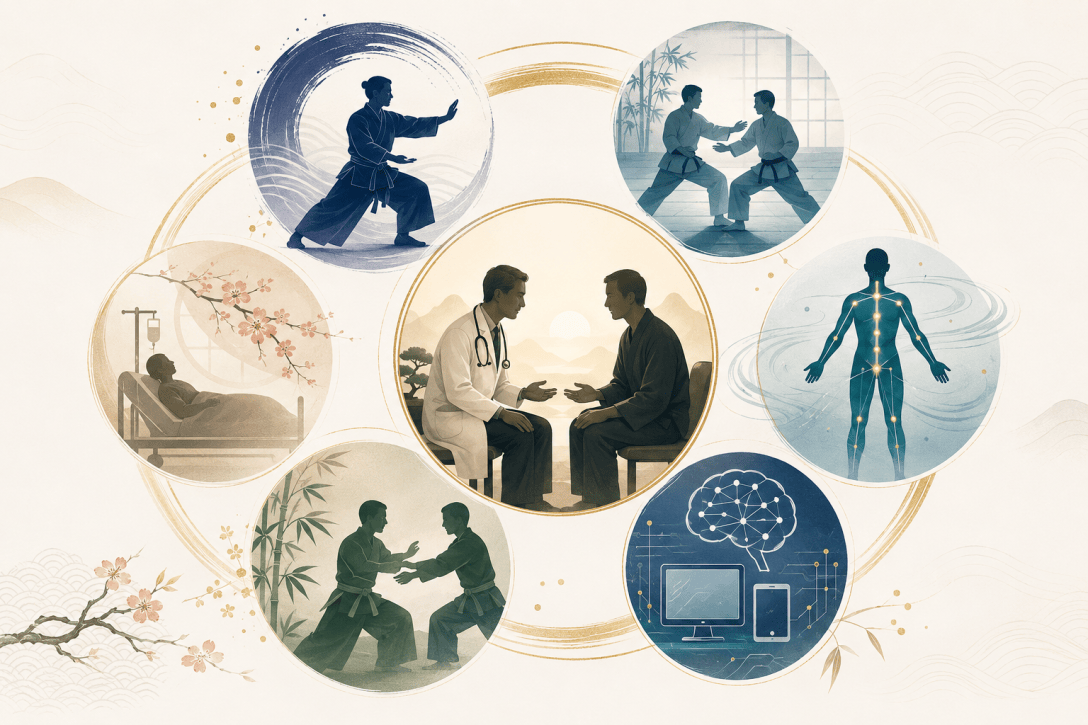
Martial arts have entered medical research primarily as exercise interventions; however, their relevance may extend further. Traditional martial arts include distinctive ways of using the body and breath, some with measurable health effects, as well as forms of physical communication in which practitioners respond to an opponent without relying on direct force. Medicine likewise involves repeated interaction, and although the physician-patient relationship has evolved to improve care, the stance clinicians should take towards disease itself is less explicitly defined. Traditional martial arts may offer one perspective. In aikido, Tomiki described aiki as matching an opponent’s movement and controlling it without opposing it by force. In chronic illness, where disease cannot always be defeated and treatment itself may impose burdens, such a stance may have clinical relevance. As artificial intelligence increasingly supports movement assessment and diagnosis, embodiment and human relationships are likely to remain fundamental to both medicine and martial arts.
Keywords: budo; embodiment; human relationship
1. Introduction
Traditional martial arts systems each have their own distinctive methods of body movement, breathing techniques, and philosophy. Some of these are built on how the body actually works, and they optimise health or performance rather than only combat (Bu et al., 2010). Tai chi is the best-studied martial art and has been associated with diverse health benefits, including improved postural stability, fewer falls, and better cardiovascular and functional outcomes (Huang et al., 2017; Li et al., 2012; Wang et al., 2016).
I have practised and taught martial arts, specifically a karate-based system of self-defence, for many years. I have also worked in clinical practice and research as a physician in internal medicine. Drawing on these two perspectives, this article views the human body through different lenses and explores the intersection between medicine and martial arts. To minimise bias arising from overreliance on my personal experience, and to allow readers without a medical background to understand and evaluate the arguments, I have grounded the discussion in evidence wherever possible.
Two elements of martial arts practice have provided important insights into my work as a physician. The first is breathing. Controlled abdominal and diaphragmatic breathing is an important component of many martial arts traditions and has been associated with favourable autonomic, cardiovascular and psychological effects (Balban et al., 2023; Hamasaki, 2020; Yau & Loke, 2021; Yeh & Ho, 2024). Martial arts are systems of body movement developed for combat, and effective practice also requires regulation of the autonomic nervous system, particularly the balance between sympathetic and parasympathetic activity and, where possible, the ability to modulate that balance voluntarily (Laborde et al., 2022). Breathing techniques provide a practical means of doing so.
The second element is how the body is organised. Although methods of body movement vary somewhat across martial arts and styles, training generally emphasises keeping the centre of gravity low while moving, using the left and right limbs in a balanced manner, and avoiding unnecessary tension in the hands and shoulders. Tai chi training that emphasises weight shifting, trunk rotation and coordinated whole-body movement improves balance and gait control in older adults (Kim, 2009; Kim et al., 2009). The biomechanics underlying these instructions are well described in rehabilitation science. Trunk stability supports the production, transfer, and control of force through the limbs (Kibler et al., 2006). Movement is organised through kinetic chains in which force and motion are coordinated across body segments, typically from proximal to distal, meaning that dysfunction in one link can affect the entire chain (Sciascia & Cromwell, 2012). Scapular stability likewise contributes to efficient function of the shoulder complex, and its impairment can compromise upper-limb mechanics (Paine & Voight, 2013). Attentional focus also influences movement organisation: an external rather than internal focus generally produces more efficient muscular activation and movement kinematics, often allowing equal or better performance with less muscular activity (Hawkins et al., 2025). In other words, optimal performance emerges when the limbs and trunk function as an integrated whole. The martial art I have trained in places particular emphasis on this principle of body movement.
Japanese classical schools of swordsmanship also emphasised the importance of breathing and body movement. In the Hojo forms of Jikishinkage-ryu, practitioners are taught to settle the mind at the tanden below the navel and to let the breath reach the fingers and toes, with every movement coordinated with breathing. Excessive spirit and unnecessary force during striking are described as causes of incorrect movement and posture (Karukome & Sakai, 2013). What modern medical research measures scientifically as weight shifting and attentional focus was described by an eighteenth-century school of swordsmanship in terms of posture and the absence of unnecessary force, and these principles were incorporated into practice. Previous research suggests that such ways of using the body may also be useful in rehabilitation and exercise therapy for lifestyle-related diseases (Bertolini et al., 2025; Wang et al., 2021; Zhang et al., 2024; Zhou et al., 2019).
The connection between martial arts practice and medicine extends beyond exercise. A martial art is also a form of physical communication with another person. The practitioner reads an opponent, controls an incoming attack, and protects the body while avoiding a direct contest of strength with a physically stronger opponent. Medicine likewise proceeds through repeated communication, using a different set of tools, while the object of medical care does not always respond as intended. Two people meet, one seeks to influence an outcome, and what unfolds depends on how the other responds. Kata training in budo is not simply the conscious movement of an individual. It seeks coordinated movement with a partner within a relationship (Uozumi, 2012). Medicine is likewise an embodied practice in which physicians use their own bodies as instruments of clinical work (Kelly et al., 2019). This structural similarity provides the starting point for this article.
2. Health benefits of martial arts
2.1 Physical health
In the medical literature, evidence for the health benefits of martial arts has focused largely on tai chi, although beneficial effects have also been reported for other martial arts. Several representative examples are considered below.
Tai chi reduces falls and improves functional mobility and balance in older adults, with greater benefits from longer and more frequent practice (Chen et al., 2023). Practice for at least 24 weeks also attenuates bone mineral density loss at the lumbar spine, femoral neck and hip in older adults and peri- and postmenopausal women (Zou et al., 2017). In people with type 2 diabetes, tai chi reduces fasting plasma glucose, glycated haemoglobin and insulin resistance, although effects vary by style and duration (Zhou et al., 2019; Xia et al., 2019). Neither 24-form nor Yang-style tai chi reduced fasting glucose, whereas other styles did after more than three months of practice. Thus, tai chi cannot be treated as a single uniform intervention, and its effects appear to depend on the specific form of practice.
A systematic review across martial arts reported that tai chi had been studied far more extensively than other disciplines, whereas research on judo, karate and taekwondo had focused mainly on athletic performance rather than health outcomes. No randomised or controlled trials were identified for aikido, kendo, sumo or kyudo (Bu et al., 2010). Thus, martial arts with long pedagogical traditions other than tai chi have been examined only rarely as health interventions. Hard martial arts may improve balance, cognition, musculoskeletal health, psychological outcomes, cardiorespiratory fitness and metabolic measures, although the evidence is limited by small samples, convenience sampling, short interventions, difficulty in blinding assessors and high dropout rates (Origua Rios et al., 2018). In older adults, adapted taekwondo and Muay Thai ritual dance improved functional mobility, while physically active controls performed better for balance and handgrip strength (de Mendonça et al., 2025). Judo-based programmes improved balance, physical performance, strength and safe-falling ability, with longer programmes also improving quality of life and bone mineral density (Chan et al., 2023). Teaching safe falling may represent a distinctive contribution of martial arts to healthcare. Taekwondo improved muscle mass, physical fitness and insulin resistance-related risk factors in sedentary older women (Park et al., 2025), while Taekkyon improved balance, lower-extremity strength and gait compared with conventional fall-prevention exercise (Kim et al., 2024). Karate improved motor reactivity, stress tolerance and divided attention in older adults, with further gains after longer training (Witte et al., 2016). The authors suggested that learning unfamiliar movements, techniques and kata contributed to these differences, as kata imposes a cognitive demand that repetitive exercise does not. The benefits of martial arts may therefore arise not solely from exercise itself, but also from having something new to learn.
One study directly links the breathing described above with force production. Trained martial arts practitioners produced and resisted greater force relative to body mass than untrained controls, with higher gastric and transdiaphragmatic pressures, greater trunk muscle activation and earlier increases in gastric pressure (Walters et al., 2021). Breathing, trunk function and force production can therefore be understood as components of a single mechanism rather than as three separate processes. This is also what the instruction to “settle the mind at the tanden” expresses in a different conceptual framework.
2.2 Mental health
Moore et al. (2020) found that martial arts training produced a small improvement in well-being and a moderate improvement in internalising mental health symptoms. No significant reduction in aggression was observed. This finding is worth noting. Martial arts training is often assumed to reduce aggression; however, the pooled evidence did not support such an effect. Martial arts cannot simply be said to reduce aggression; their effects vary depending on the nature of the training, instructional approach, emphasis on traditional values, and degree of competitive orientation (Lafuente et al., 2021).
A cross-sectional study of practitioners of Japanese martial arts found higher dispositional mindfulness and subjective well-being and lower depressive symptoms than in demographically matched non-practitioners (Miyata et al., 2020). Among practitioners, longer practice was associated with greater mindfulness and subjective well-being, while more frequent practice was associated with fewer depressive symptoms. These findings cannot establish causality, since individuals with better psychological health may also be more likely to begin or continue martial arts practice. However, long-term martial arts practice may contribute to greater psychological stability.
A feasibility study implemented Budo group therapy in a psychiatric hospital and found good retention, particularly among outpatients, together with high satisfaction and motivation and strong interest in repeated participation and continuation after discharge (Singh et al., 2024). The importance of this study lies less in demonstrating efficacy than in demonstrating feasibility and sustained engagement. Maintaining participation in physical activity is a major challenge in psychiatric care, and the repeated attendance observed here suggests that budo may offer one way of keeping patients engaged.
2.3 Beyond physical effects: from body control to embodied skill
Beyond objectively measurable parameters, martial arts may also have important effects on how the body is used and controlled. Many instructions used in martial arts have close parallels in rehabilitation science. Efficient movement depends on the body working as an integrated whole rather than as a collection of separate parts. A stable trunk provides a base from which force can be generated and transferred to the arms and legs (Kibler et al., 2006). The kinetic chain describes how movement and force pass through linked body segments, often from the legs and trunk towards the arm. If one part of this chain does not work properly, other parts may have to compensate, making movement less efficient and increasing stress on the joints (Sciascia & Cromwell, 2012). The shoulder provides another example. The shoulder blade must be positioned and controlled effectively to give the arm a stable base for movement. Poor scapular control can reduce shoulder function and increase stress on surrounding tissues (Paine & Voight, 2013). Many martial arts teach practitioners to optimise the kinetic chain to improve performance. How movement is taught also matters. Instructions that direct attention towards the effect of a movement, rather than towards individual body parts, generally allow movement to be organised more efficiently (Hawkins et al., 2025). I argue that one of the ultimate aims of martial arts training is to learn to use the body as a truly integrated whole, from the trunk to the extremities.
Phenomenology offers another way to understand what happens as a person learns to move. In ordinary skilled activity, the body often recedes from conscious attention. Pain can reverse this relationship and make the body intrude on experience, a phenomenon described as dys-appearance. The body can also come to awareness positively, as something that feels strong, controlled or at ease, which has been described as eu-appearance (Zeiler, 2010). A similar change occurs when people learn wheelchair skills. At first, they must consciously attend to their posture, arms and the wheelchair itself. With practice, these details require less attention and the wheelchair can become incorporated into their habitual way of moving through the world (Standal, 2011). Martial arts training can follow a comparable path. Beginners often have to think consciously about posture, balance and individual movements. With practice, these elements can become part of embodied skill, allowing attention to shift from controlling the body to acting through it. Experienced martial artists can perform repeatedly refined patterns of body movement almost unconsciously. In my martial art, this state is called mukyoku. In Japanese, mu means “emptiness” and kyoku means “ultimate”.
3. Physician-patient relationship
3.1 From paternalism and the four models
Thus far, the discussion has focused on the body of the individual who practises martial arts. I would now like to turn to the relationship with another person or with the object of one’s actions. In medicine, the primary person involved is the patient. The physician-patient relationship has important parallels with interpersonal training in martial arts.
Historically, the physician-patient relationship was largely asymmetrical. The physician selected the interventions considered most likely to restore health and controlled the information given to the patient in order to obtain agreement (Kaba & Sooriakumaran, 2007).
A widely used framework distinguishes four models of the physician-patient relationship (Emanuel & Emanuel, 1992). In the paternalistic model, the physician acts as a guardian and recommends what is considered best for the patient. In the informative model, the physician provides the relevant facts and the patient chooses according to their own values. In the interpretive model, the physician helps the patient clarify those values and relate them to available options. In the deliberative model, physician and patient discuss which health-related values should guide the decision, with the physician acting partly as a teacher or adviser.
Emanuel and Emanuel (1992) argue that the deliberative model is the ideal because the informative model offers too narrow a view of autonomy and risks reducing the physician to a technologist. Autonomy, in their account, is not simply choosing an option from a list. It involves critically examining one’s values, deciding which should guide action, and then acting accordingly. They describe the essence of doctoring as a combination of knowledge, understanding, teaching and action.
They also note that these models extend beyond medicine. Elements of the deliberative model can be found in relationships between lawyer and client, religious mentor and follower, and educator and student. The relationship between teacher and student in a dojo can also be understood in this way.
3.2 From patient-centredness to mutual influence
Patient-centredness was given a conceptual framework and examined against the empirical literature at the turn of the century (Mead & Bower, 2000). The move away from paternalism towards respect for patient autonomy changed the purpose of the clinical consultation (Kilbride & Joffe, 2018). Informed consent had focused mainly on disclosure, often with less attention to whether patients truly understood their options. Shared decision making developed in part to address this limitation (Childress & Childress, 2020).
Three decades ago, a new model of the patient-physician relationship was proposed (Balint & Shelton, 1996). Relationship-centred care subsequently emphasised that clinical relationships involve the personhood of both participants and that affect and emotion are legitimate parts of those relationships (Beach et al., 2006). Buber’s existential philosophy has also been used to understand healing relationships in similar terms (Scott et al., 2009). Balint’s work on the doctor-patient relationship and his group discussions with general practitioners helped establish the consultation itself as an object of study (Lakasing, 2005). More recent work has extended this perspective to authenticity, understood as consistency between the physician’s outward behaviour and internal state rather than communication technique alone (Fuehrer et al., 2024).
One concept is particularly important to the argument of this article. When patients and physicians were asked which attitudes and behaviours enable shared decision making, their responses were described in terms of mutual influence (Lown et al., 2009). The consultation is therefore not simply a process in which one person teaches or directs the other. Each participant can influence and be influenced by the other. This reciprocal relationship has a close parallel in training with a partner in a dojo and provides an important point of connection between medicine and martial arts.
4. Budo: beyond combat
4.1 From combat to character formation
Budo, or Japanese martial arts, originated as practical systems of combat in which survival and victory were immediate concerns (Abe, 1992; Hurst, 1998). Victory was not merely a matter of relative superiority over an opponent. It was bound to survival itself, and systems of technique were developed to secure it decisively (Abe, 1992).
Early modern Japanese martial arts texts repeatedly discuss the idea of transcending victory and defeat. It may be tempting to interpret this as an early form of non-violence, yet the historical sources do not support such a reading. In the Yagyu Shinkage-ryu tradition, letting go of the desire to win and the fear of losing enables the practitioner to read the opponent’s mind. Jigen-ryu texts similarly advocate detachment in order to strike before doubt or fear can interfere. Only a third group of texts treats transcendence of victory and defeat as an end in itself, as a means of fully pursuing the way of life and death (Abe, 1992). Thus, in much of the literature of this period, transcending victory and defeat was also a means of winning more reliably.
A systematic examination of spirituality in early modern swordsmanship texts distinguishes artistic and truth-seeking spirituality from ethical and moral spirituality. Clear descriptions of the latter are found in only a few cases across the early modern period. The idea that ethical or character development is the purpose of training and a defining feature of budo appears to have emerged in the modern period. Early modern texts instead developed the former type of spirituality. The concept of mushin, or absence of mind, was articulated in the early period and transmitted into the middle period, while theories centred on ki developed from the middle period onwards (Murakami et al., 2016).
This provides historical grounds for considering the purpose of martial arts to have changed over time. The change is real, and relatively recent.
4.2 Beyond combat and towards human relations
Martial arts principles have been extended beyond combat before. Takuan Soho influenced the spiritual theories of Japanese martial arts through his relationship with Yagyu Munenori, and his Fudochi Shinmyoroku contributed to Munenori’s Heiho Kadensho (Ohishi, 2013). In this transmission, the principles of mind developed for martial arts practice were extended to political governance and human relationships more broadly. The attempt made in this article to carry martial arts principles into the clinical encounter may be said to have a historical precedent.
A similar extension can be seen in the concept of aiki. The term has referred both to particular techniques and to a spiritual state. Morihei Ueshiba, influenced by the Omoto religion and Onisaburo Deguchi, increasingly associated aiki with harmony and love. In Budo Renshu of 1933, he argued that true budo should not merely destroy an enemy, but should lead the opponent to relinquish the will to oppose and should ultimately serve harmony. After the war, he stated that love does not contend and has no enemy (Kudo & Shishida, 2010).
This interpretation was not shared uniformly by his students. Kenji Tomiki understood aiki more practically as adapting one’s movement to that of the opponent, avoiding unnecessary opposition while still retaining control. Tomiki also introduced competition, arguing that safe contests allowed practitioners to assess their own ability, correct themselves through interaction with others, and broaden the sphere of harmony. Kisshomaru Ueshiba opposed competition and effectively prohibited matches (Kudo & Shishida, 2010). The meaning of not fighting remained contested within budo itself. In aikido, despite differences in interpretation, the concept of aiki in interpersonal relationships and as a spiritual state may have parallels with mutual influence in the physician-patient relationship (Lown et al., 2009). Through communication, physicians and patients influence one another and work together in decision making with the shared aim of achieving successful treatment. Once the relationship becomes adversarial, effective treatment becomes difficult.
The relationship between martial arts practice and medicine is also not uniquely Japanese. In Kanyakumari in southern India, varmakkalai treats vital points of the body as sites that can both incapacitate an opponent and be used therapeutically. The modern separation of martial arts from medicine and science does not necessarily reflect the way such traditions themselves were organised (Sieler, 2012). Therefore, the connection proposed here belongs to a broader history in which martial arts and healing practices have sometimes overlapped.
4.3 From technique to embodied practice
Martial arts training can also change the way the practitioner experiences and uses the body. The Hojo forms occupy a central place in Jikishinkage-ryu and are practised in the first and second stages of its curriculum. In the first stage, duelling is prohibited. The desire to advance and defeat opponents is regarded as an obstacle to training, while excessive spirit and forceful striking are said to produce incorrect movement and posture (Karukome & Sakai, 2013). Not fighting is therefore more than an ethical ideal in this context. It is a technical condition of learning because the desire to win can interfere with the formation of correct movement.
A related idea appears in accounts of kendo training. Buddhist ascetic practice aims directly at disciplining the mind, whereas kendo training is directed primarily towards the acquisition and refinement of technique. Mental discipline develops through that process. The states described as desirable include the ordinary mind, absence of mind, immovable wisdom, and the clear mirror and still water. In contest, the practitioner is instructed to abandon the stopping mind, surprise, fear, doubt, confusion and desire. In mind-body terms, Takeda (1982) describes the result as a state in which the distinction between the body as subject and the body as object is overcome, and the body as object becomes fully subject.
Modern budo offers another formulation of this process. Uozumi (2012) describes budo as a movement culture formed at the end of the nineteenth century through both engagement with and resistance to Western modern sport. Concepts such as koshi, hara, tanden, ki and maai refer to bodily sensations and structures of technique that differ from those commonly emphasised in modern sport. In kata practice, the goal is not simply for an isolated individual to execute a consciously controlled movement. The practitioner learns to move with another person within a relationship. Uozumi interprets this as a way of understanding the human being that moves beyond both the subject-object distinction and mind-body dualism.
5. Medicine: beyond defeating disease
The relief of suffering has long been a central obligation of medicine; however, suffering itself has received relatively little explicit attention in medical education and research. Suffering is experienced by persons, not simply by bodies, and arises when the integrity of the person is threatened. Even in high-quality care delivered by competent and genuinely concerned physicians, treatment itself can become a source of suffering alongside the disease (Cassel, 1982). When defeating disease becomes the sole aim of care, the patient’s personhood and social circumstances may be sacrificed in the process.
The problem-oriented approach was historically reasonable and effective. It no longer adequately meets the needs of many patients and clinicians. Its limitations are reflected in clinician demoralisation and burnout, patient dissatisfaction and non-adherence, overdiagnosis and labelling, polypharmacy and iatrogenic harm, unwanted end-of-life interventions, unacceptable disparities, and rising healthcare costs. Contemporary care increasingly calls for a shift in focus from abnormalities identified by clinicians to goals that matter to patients, with a greater role for patients and more individualised care (Mold, 2022).
Chronic disease is a major health challenge of our time, and the treatment strategies developed to manage it have, paradoxically, placed an increasing burden on patients. Treatment intended to control disease can itself contribute to poor adherence, wasted healthcare resources, and worse patient outcomes. Minimally disruptive medicine seeks to fit treatment regimens to the realities of patients’ daily lives (May et al., 2009). This model has since been developed into a practical and comprehensive approach for patients with multiple chronic conditions (Leppin et al., 2015).
Attempting to defeat disease by using every available medical resource does not necessarily improve a patient’s quality of life or well-being. The changing philosophy of medicine may have parallels with the historical transformation in the purpose of martial arts. In some circumstances, choosing not to fight the disease may lead to better outcomes for both patients and clinicians. When defeating disease is no longer the primary aim of medicine, the physician-patient relationship may become more equal than it is today. In my experience, it may come to resemble the relationship between practitioners who train together in a dojo and help one another improve. This issue of human relationships becomes even more important with the development of artificial intelligence (AI).
6. The impact of AI
6.1 The physician-patient relationship in the age of AI
As AI increasingly exceeds human capabilities in some cognitive tasks, the role of the physician may need to be reconsidered from its foundation. Generative AI can already support diagnosis, documentation, education and the provision of medical information, while its limitations and risks remain substantial (Lee et al., 2023). A recent scoping review found that generative AI may improve efficiency, expand access to health information and support some aspects of communication, while also carrying the risk of recasting the clinician as a technical supervisor rather than a humanistic care provider (Hahne & Carpenter, 2026). If machines increasingly provide information and cognitive support more efficiently than humans, preserving a meaningful role for physicians will require more than supervising technology. The physician-patient relationship itself may need to become more explicitly collaborative. Patient-centred communication already emphasises mutual trust, understanding, involvement in decision making, attention to patient values and support for self-management (Hahne & Carpenter, 2026). Emanuel and Emanuel (1992) similarly argued that the physician should not be reduced to a technologist who merely supplies facts. They proposed a more deliberative relationship in which physician and patient actively contribute to understanding values and deciding how to act. In this sense, the future physician-patient relationship may resemble training partners in a dojo more closely than the traditional hierarchy of expert and recipient. The relationship would be more equal, with both participants contributing to a shared process of understanding and decision making. The physician’s task would not simply be to provide medical knowledge, but to help the patient understand that knowledge, place it within the context of their own life, and develop strategies for living with disease while pursuing well-being. This is consistent with the view that medicine should preserve the patient-physician relationship as its most fundamental element even as technology changes clinical practice (Noseworthy, 2019).
Such a relationship also requires a change in the physician’s attitude. If physician and patient are partners rather than one-way providers and recipients of knowledge, learning can occur in both directions. The physician must be prepared to learn from the patient’s experience, values and understanding of life with illness. Clinical encounters may therefore be understood not only as opportunities to treat patients, but also as opportunities for physicians themselves to learn and grow. Recognising and valuing that opportunity may become an increasingly important professional skill in an age when technical knowledge alone no longer defines the physician’s contribution.
6.2 AI and the future of martial arts practice
AI is also increasingly being applied across martial arts and has the potential to change training, competition and education. A broad survey of the field identified applications including action recognition, pose estimation, movement evaluation, support for elite athletes, health-related applications and other forms of technical analysis (Pang, Wang, et al., 2025). In karate, a computer-based guidance system has been developed to recognise movements in kata, identify errors and provide feedback for subsequent practice (Emad et al., 2020). Machine-learning systems for Chinese martial arts can now evaluate movement quality with performance approaching that of human experts and provide interpretable feedback for teaching and learning (Pang, Zhang, et al., 2025). In taekwondo, AI has been proposed for performance analysis, motion tracking and virtual coaching, while more recent systems integrate motion analysis with augmented reality to provide personalised feedback in real time (Shin et al., 2024; Yang & Wang, 2025). These developments suggest that parts of martial arts instruction and assessment that depend on observing, comparing and correcting visible movement can increasingly be supported by AI.
Important limitations remain. Martial arts movements are fast, complex, three-dimensional and highly variable. Pose-estimation systems can misidentify keypoints in unusual martial arts postures, two-dimensional coordinates cannot fully represent three-dimensional movement, and differences in speed, rhythm and physical condition complicate comparisons between a practitioner’s movement and a standard model (Pang, Zhang, et al., 2025). Occlusion, complex backgrounds, multiple practitioners and rapid transitions also remain technical challenges, even as multimodal sensors and increasingly sophisticated models improve performance (Sun et al., 2025). Therefore, current systems represent and evaluate selected measurable features of martial movement rather than reproduce the entirety of martial practice.
This distinction is particularly important for the argument of this article. Martial arts training does not consist solely of reproducing externally observable movements. As discussed above, practitioners learn to organise the body as an integrated whole, coordinate breathing with movement and gradually acquire skills that no longer require conscious control of individual body parts. AI may observe these processes, quantify some of their features and even provide useful corrective feedback. It does not itself undergo the bodily process through which such embodied skill is acquired. The same distinction applies to the potential health effects discussed earlier. An AI system may teach or monitor breathing and movement; however, it cannot perform the practice on behalf of the practitioner. The physiological and experiential effects arise from what the human body repeatedly does.
Advances in technology will nevertheless change martial arts training, and there is little reason to assume that the dojo will remain technically unchanged. The more interesting question may be what becomes more important when technical analysis can increasingly be delegated to machines. If the purpose of martial arts extends beyond winning and technical proficiency to include self-cultivation, mutual development and learning through interaction with others, these aspects depend on relationships between people. A machine may identify an incorrect posture more precisely than an instructor in some circumstances; however, training with another person involves adapting to another body, responding to another person’s intentions and limitations, and being changed through that interaction. Thus, the dojo may become more rather than less important in the age of AI, not simply as a place where techniques are transmitted, but as a place where people practise together and form relationships through which both embodied skill and the purposes of martial arts beyond victory can develop.
7. Conclusions
This article has shown that martial arts training includes distinctive approaches to body use, and that these may have applications in rehabilitation and exercise therapy. The physician-patient relationship has changed over time, partly because the outcomes sought in medicine have also changed across historical periods and differ between individual patients. This transformation can be understood in analogy with changes in the purposes of martial arts. Martial arts came to be practised for aims extending beyond combat, including character development and philosophical ideals such as learning how to live without fighting.
The emergence and rapid development of AI are now exerting major effects on both medicine and martial arts. Both fields continue to change with the times. Human relationships, however, are likely to remain. In medicine, this means the relationship between physician and patient. In the dojo, it includes relationships between teacher and student and between training partners. From my experience as both a physician and a martial artist, I suggest that the physician-patient relationship may increasingly come to resemble that between training partners in a dojo, a relationship characterised by mutual influence in which both participants contribute to the development of the other.
Medicine and martial arts may also have much to learn from one another. Although this lies beyond the scope of the present article, Western medicine, which is the dominant medical tradition internationally, may find useful perspectives in Buddhist and non-dualistic ideas embedded in East Asian martial traditions when reconsidering how disease should be approached (Nagatomo & Leisman, 1996; Priest, 2013). Martial arts, in turn, remain strongly shaped by hierarchical and sometimes authoritarian teacher-student relationships. They may therefore learn from the redistribution of authority that medicine has already undergone, from paternalism to informed consent and subsequently to shared decision making (Childress & Childress, 2020). However far AI develops, and however much these fields change, what remains in martial arts is a body that exists in relation to another person, while what remains in medicine is a body that exists in relation to a patient. Neither field can be completed by an isolated body alone. Both necessarily retain a relationship with another person. It is here that the ideal of not fighting acquires particular significance. What is required is not opposition, but a relationship in which people influence, learn from and help one another to develop.
REFERENCES
Abe, T. (1992). A study on the value of victory or defeat of budo: From modern kenjutsu densho. Research Journal of Budo, 24(3), 16–25. https://doi.org/10.11214/budo1968.24.3_16
Balban, M. Y., Neri, E., Kogon, M. M., Weed, L., Nouriani, B., Jo, B., Holl, G., Zeitzer, J. M., Spiegel, D., & Huberman, A. D. (2023). Brief structured respiration practices enhance mood and reduce physiological arousal. Cell Reports Medicine, 4(1), 100895. https://doi.org/10.1016/j.xcrm.2022.100895
Balint, J., & Shelton, W. (1996). Regaining the initiative. Forging a new model of the patient-physician relationship. JAMA, 275(11), 887–891. https://doi.org/10.1001/jama.275.11.887
Beach, M. C., Inui, T., & Relationship-Centered Care Research Network. (2006). Relationship-centered care: A constructive reframing. Journal of General Internal Medicine, 21(Suppl 1), S3–S8. https://doi.org/10.1111/j.1525-1497.2006.00302.x
Bertolini, R., Vercelino, R., Ferreira, L. F., & Telles da Rosa, L. H. (2025). Effects of Tai Chi Chuan on older adults’ balance: A systematic review with meta-analysis. Journal of Aging and Physical Activity, 33(1), 84–97. https://doi.org/10.1123/japa.2023-0423
Bu, B., Haijun, H., Yong, L., Chaohui, Z., Xiaoyuan, Y., & Singh, M. F. (2010). Effects of martial arts on health status: A systematic review. Journal of Evidence-Based Medicine, 3(4), 205–219. https://doi.org/10.1111/j.1756-5391.2010.01107.x
Cassel, E. J. (1982). The nature of suffering and the goals of medicine. New England Journal of Medicine, 306(11), 639–645. https://doi.org/10.1056/NEJM198203183061104
Chan, U., Ayliffe, L., Visvanathan, R., Headland, M., Verma, M., & Jadczak, A. D. (2023). Judo-based exercise programs to improve health outcomes in middle-aged and older adults with no judo experience: A scoping review. Geriatrics & Gerontology International, 23(3), 163–178. https://doi.org/10.1111/ggi.14553
Chen, W., Li, M., Li, H., Lin, Y., & Feng, Z. (2023). Tai Chi for fall prevention and balance improvement in older adults: A systematic review and meta-analysis of randomized controlled trials. Frontiers in Public Health, 11, 1236050. https://doi.org/10.3389/fpubh.2023.1236050
Childress, J. F., & Childress, M. D. (2020). What does the evolution from informed consent to shared decision making teach us about authority in health care? AMA Journal of Ethics, 22(5), E423–E429. https://doi.org/10.1001/amajethics.2020.423
de Mendonça, D. L. C., Raider Junior, J. M., da Silva, L. B. B., Alonso, A. C., Greve, J. M. D., & Garcez-Leme, L. E. (2025). Benefits of martial arts on the functional capacity of elderly people: A systematic review and meta-analysis. Clinics, 80, 100830. https://doi.org/10.1016/j.clinsp.2025.100830
Emad, B., Atef, O., Shams, Y., El-Kerdany, A., Shorim, N., Nabil, A., & Atia, A. (2020). iKarate: Karate kata guidance system. Procedia Computer Science, 175, 149–156. https://doi.org/10.1016/j.procs.2020.07.024
Emanuel, E. J., & Emanuel, L. L. (1992). Four models of the physician-patient relationship. JAMA, 267(16), 2221–2226. https://doi.org/10.1001/jama.1992.03480160079038
Fuehrer, S., Weil, A., Osterberg, L. G., Zulman, D. M., Meunier, M. R., & Schwartz, R. (2024). Building authentic connection in the patient-physician relationship. Journal of Primary Care & Community Health, 15, 21501319231225996. https://doi.org/10.1177/21501319231225996
Hahne, J., & Carpenter, B. D. (2026). Patient and clinician engagement with generative artificial intelligence (GenAI): A scoping review of implications for patient-centered communication. Patient Education and Counseling, 145, 109492. https://doi.org/10.1016/j.pec.2026.109492
Hamasaki, H. (2020). Effects of diaphragmatic breathing on health: A narrative review. Medicines, 7(10), 65. https://doi.org/10.3390/medicines7100065
Hawkins, T. E., Alder, D. B., Bennett, T. B., & Poolton, J. M. (2025). The influence of external and internal focus of attention instructions on the organization of movement: A systematic review. Journal of Motor Learning and Development, 13(2), 339–365. https://doi.org/10.1123/jmld.2024-0065
Huang, Z. G., Feng, Y. H., Li, Y. H., & Lv, C. S. (2017). Systematic review and meta-analysis: Tai Chi for preventing falls in older adults. BMJ Open, 7(2), e013661. https://doi.org/10.1136/bmjopen-2016-013661
Hurst, G. C., III. (1998). Armed martial arts of Japan: Swordsmanship and archery. Yale University Press.
Kaba, R., & Sooriakumaran, P. (2007). The evolution of the doctor-patient relationship. International Journal of Surgery, 5(1), 57–65. https://doi.org/10.1016/j.ijsu.2006.01.005
Karukome, Y., & Sakai, T. (2013). An analysis of Hōjō in Jikishinkage-ryū. Research Journal of Physical Arts, 18, 43–57. https://doi.org/10.51078/physicalarts.2013.004
Kelly, M., Ellaway, R., Scherpbier, A., King, N., & Dornan, T. (2019). Body pedagogics: Embodied learning for the health professions. Medical Education, 53(10), 967–977. https://doi.org/10.1111/medu.13916
Kibler, W. B., Press, J., & Sciascia, A. (2006). The role of core stability in athletic function. Sports Medicine, 36(3), 189–198. https://doi.org/10.2165/00007256-200636030-00001
Kilbride, M. K., & Joffe, S. (2018). The new age of patient autonomy: Implications for the patient-physician relationship. JAMA, 320(19), 1973–1974. https://doi.org/10.1001/jama.2018.14382
Kim, C. Y., Jeong, H. W., Baek, C. Y., Kim, S. W., & Kim, H. D. (2024). Effects of Taekkyon-based exercise program on balance, lower extremity strength, and gait parameters in community-dwelling older women: Randomized controlled trial. Medicine, 103(11), e37463. https://doi.org/10.1097/MD.0000000000037463
Kim, H. D. (2009). Effects of Tai Chi exercise on the center of pressure trace during obstacle crossing in older adults who are at a risk of falling. Journal of Physical Therapy Science, 21(1), 49–54. https://doi.org/10.1589/jpts.21.49
Kim, H. D., Han, J. T., & Cho, Y. H. (2009). The effectiveness of community-based Tai Chi training on balance control during stair descent by older adults. Journal of Physical Therapy Science, 21(4), 317–323. https://doi.org/10.1589/jpts.21.317
Kudo, R., & Shishida, F. (2010). The meaning of aiki in Aikido: Focusing on comments made by Morihei Ueshiba and his pupils. Japan Journal of Physical Education, Health and Sport Sciences, 55(2), 453–469. https://doi.org/10.5432/jjpehss.09024
Laborde, S., Allen, M., Borges, U., Dosseville, F., Hosang, T., Iskra, M., Mosley, E., Salvotti, C., Spolverato, L., Zammit, N., & Javelle, F. (2022). Effects of voluntary slow breathing on heart rate and heart rate variability: A systematic review and a meta-analysis. Neuroscience & Biobehavioral Reviews, 138, 104711. https://doi.org/10.1016/j.neubiorev.2022.104711
Lafuente, J. C., Zubiaur, M., & Gutiérrez-García, C. (2021). Effects of martial arts and combat sports training on anger and aggression: A systematic review. Aggression and Violent Behavior, 58, 101611. https://doi.org/10.1016/j.avb.2021.101611
Lakasing, E. (2005). Michael Balint—an outstanding medical life. British Journal of General Practice, 55(518), 724–725.
Lee, P., Bubeck, S., & Petro, J. (2023). Benefits, limits, and risks of GPT-4 as an AI chatbot for medicine. New England Journal of Medicine, 388(13), 1233–1239. https://doi.org/10.1056/NEJMsr2214184
Leppin, A., Montori, V., & Gionfriddo, M. (2015). Minimally disruptive medicine: A pragmatically comprehensive model for delivering care to patients with multiple chronic conditions. Healthcare, 3(1), 50–63. https://doi.org/10.3390/healthcare3010050
Li, F., Harmer, P., Fitzgerald, K., Eckstrom, E., Stock, R., Galver, J., Maddalozzo, G., & Batya, S. S. (2012). Tai chi and postural stability in patients with Parkinson’s disease. New England Journal of Medicine, 366(6), 511–519. https://doi.org/10.1056/NEJMoa1107911
Lown, B. A., Hanson, J. L., & Clark, W. D. (2009). Mutual influence in shared decision making: A collaborative study of patients and physicians. Health Expectations, 12(2), 160–174. https://doi.org/10.1111/j.1369-7625.2008.00525.x
May, C., Montori, V. M., & Mair, F. S. (2009). We need minimally disruptive medicine. BMJ, 339, b2803. https://doi.org/10.1136/bmj.b2803
Mead, N., & Bower, P. (2000). Patient-centredness: A conceptual framework and review of the empirical literature. Social Science & Medicine, 51(7), 1087–1110. https://doi.org/10.1016/s0277-9536(00)00098-8
Miyata, H., Kobayashi, D., Sonoda, A., Motoike, H., & Akatsuka, S. (2020). Mindfulness and psychological health in practitioners of Japanese martial arts: A cross-sectional study. BMC Sports Science, Medicine and Rehabilitation, 12(1), 75. https://doi.org/10.1186/s13102-020-00225-5
Mold, J. W. (2022). Failure of the problem-oriented medical paradigm and a person-centered alternative. The Annals of Family Medicine, 20(2), 145–148. https://doi.org/10.1370/afm.2782
Moore, B., Dudley, D., & Woodcock, S. (2020). The effect of martial arts training on mental health outcomes: A systematic review and meta-analysis. Journal of Bodywork and Movement Therapies, 24(4), 402–412. https://doi.org/10.1016/j.jbmt.2020.06.017
Murakami, R., Sakai, T., Karukome, Y., & Kanzaki, H. (2016). The study on the minds of kenjutsu in the Edo period. Research Journal of Physical Arts, 21, 13–36. https://doi.org/10.51078/physicalarts.2016.002
Nagatomo, S., & Leisman, G. (1996). An east Asian perspective of mind-body. Journal of Medicine and Philosophy, 21(4), 439–466. https://doi.org/10.1093/jmp/21.4.439
Noseworthy, J. (2019). The future of care—Preserving the patient-physician relationship. New England Journal of Medicine, 381(23), 2265–2269. https://doi.org/10.1056/NEJMsr1912662
Ohishi, J. (2013). A study of Zen monk Takuan Sōhō: Researching of his human network and the development of the spiritual theory. Research Journal of Physical Arts, 18, 13–27. https://doi.org/10.51078/physicalarts.2013.002
Origua Rios, S., Marks, J., Estevan, I., & Barnett, L. M. (2018). Health benefits of hard martial arts in adults: A systematic review. Journal of Sports Sciences, 36(14), 1614–1622. https://doi.org/10.1080/02640414.2017.1406297
Paine, R., & Voight, M. L. (2013). The role of the scapula. International Journal of Sports Physical Therapy, 8(5), 617–629.
Pang, Y., Wang, Y., Wang, Q., Li, F., Zhang, C., & Ding, C. (2025). Applications of AI in martial arts: A survey. Proceedings of the Institution of Mechanical Engineers, Part P: Journal of Sports Engineering and Technology, 239(2), 301–331. https://doi.org/10.1177/17543371241273827
Pang, Y., Zhang, K., & Li, F. (2025). Explainable quality assessment of effective aligned skeletal representations for martial arts movements by multi-machine learning decisions. Scientific Reports, 15(1), 323. https://doi.org/10.1038/s41598-024-83475-4
Park, J., Kim, B., Jeong, M., Jung, H. H., Hong, G., & Park, S. K. (2025). Effects of Taekwondo training on thigh muscle cross-sectional area, health-related physical fitness, HbA1c, and GLP-1 in sedentary older women. Frontiers in Sports and Active Living, 7, 1553202. https://doi.org/10.3389/fspor.2025.1553202
Priest, G. (2013). The martial arts and Buddhist philosophy. Royal Institute of Philosophy Supplement, 73, 17–28. https://doi.org/10.1017/S1358246113000246
Sciascia, A., & Cromwell, R. (2012). Kinetic chain rehabilitation: A theoretical framework. Rehabilitation Research and Practice, 2012, 853037. https://doi.org/10.1155/2012/853037
Scott, J. G., Scott, R. G., Miller, W. L., Stange, K. C., & Crabtree, B. F. (2009). Healing relationships and the existential philosophy of Martin Buber. Philosophy, Ethics, and Humanities in Medicine, 4(1), 11. https://doi.org/10.1186/1747-5341-4-11
Shin, M. C., Lee, D. H., Chung, A., & Kang, Y. W. (2024). When Taekwondo meets artificial intelligence: The development of Taekwondo. Applied Sciences, 14(7), 3093. https://doi.org/10.3390/app14073093
Sieler, R. (2012). Kaḷari and vaittiyacālai: Medicine and martial arts intertwined. Asian Medicine, 7(1), 164–195. https://doi.org/10.1163/15734218-12341247
Singh, J., Jawhari, K., Jaffé, M., Imfeld, L., Rabenschlag, F., Moeller, J., Nienaber, A., Lang, U. E., & Huber, C. G. (2024). Implementation of a Budo group therapy for psychiatric in- and outpatients: A feasibility study. Frontiers in Psychiatry, 15, 1338484. https://doi.org/10.3389/fpsyt.2024.1338484
Standal, Ø. F. (2011). Re-embodiment: Incorporation through embodied learning of wheelchair skills. Medicine, Health Care and Philosophy, 14(2), 177–184. https://doi.org/10.1007/s11019-010-9286-8
Sun, Y., Deng, R., & Wei, D. (2025). ST-LineNet: A spatiotemporal network for real-time 3D pose estimation in martial arts training. Alexandria Engineering Journal, 117, 136–147. https://doi.org/10.1016/j.aej.2024.12.097
Takeda, R. (1982). Kendō ni okeru shugyō no seishinteki tokusei ni tsuite [On the spiritual characteristics of shugyō in kendo]. Research Journal of Budo, 15(2), 21–22. https://doi.org/10.11214/budo1968.15.2_21
Uozumi, T. (2012). Considering comparative cultural theory in budo: The possibilities for postmodern human understanding through budo. Research Journal of Budo, 44(3), 121–134. https://doi.org/10.11214/budo.44.121
Walters, S., Hoffman, B., MacAskill, W., Johnson, M. A., Sharpe, G. R., & Mills, D. E. (2021). The control of respiratory pressures and neuromuscular activation to increase force production in trained martial arts practitioners. European Journal of Applied Physiology, 121(12), 3333–3347. https://doi.org/10.1007/s00421-021-04800-7
Wang, L., Ye, M., Xiong, J., Wang, X., Wu, J., & Zheng, G. (2021). Optimal exercise parameters of tai chi for balance performance in older adults: A meta-analysis. Journal of the American Geriatrics Society, 69(7), 2000–2010. https://doi.org/10.1111/jgs.17094
Wang, X., Pi, Y., Chen, P., Liu, Y., Wang, R., Li, X., Chen, B., Zhu, Y., Yang, Y., & Niu, Z. (2016). Traditional Chinese exercise for cardiovascular diseases: Systematic review and meta-analysis of randomized controlled trials. Journal of the American Heart Association, 5(3), e002562. https://doi.org/10.1161/JAHA.115.002562
Witte, K., Kropf, S., Darius, S., Emmermacher, P., & Böckelmann, I. (2016). Comparing the effectiveness of karate and fitness training on cognitive functioning in older adults-a randomized controlled trial. Journal of Sport and Health Science, 5(4), 484–490. https://doi.org/10.1016/j.jshs.2015.09.006
Xia, T. W., Yang, Y., Li, W. H., Tang, Z. H., Li, Z. R., & Qiao, L. J. (2019). Different training durations and styles of tai chi for glucose control in patients with type 2 diabetes: A systematic review and meta-analysis of controlled trials. BMC Complementary and Alternative Medicine, 19(1), 63. https://doi.org/10.1186/s12906-019-2475-y
Yang, F., & Wang, Z. (2025). An intelligent taekwondo coaching system based on augmented reality technology with real-time feedback mechanisms. Scientific Reports, 15(1), 40832. https://doi.org/10.1038/s41598-025-24608-1
Yau, K. K. Y., & Loke, A. Y. (2021). Effects of diaphragmatic deep breathing exercises on prehypertensive or hypertensive adults: A literature review. Complementary Therapies in Clinical Practice, 43, 101315. https://doi.org/10.1016/j.ctcp.2021.101315
Yeh, T. T., & Ho, Y. C. (2024). Immediate effects of structured and natural deep breathing on heart rate variability and blood pressure in community-dwelling older adults. Experimental Gerontology, 198, 112644. https://doi.org/10.1016/j.exger.2024.112644
Zeiler, K. (2010). A phenomenological analysis of bodily self-awareness in the experience of pain and pleasure: On dys-appearance and eu-appearance. Medicine, Health Care and Philosophy, 13(4), 333–342. https://doi.org/10.1007/s11019-010-9237-4
Zhang, W., Wang, H., Xiong, Z., & Li, C. (2024). Efficacy of Tai Chi exercise in patients with hypertension: Systematic review and meta-analysis. Current Problems in Cardiology, 49(11), 102798. https://doi.org/10.1016/j.cpcardiol.2024.102798
Zhou, Z., Zhou, R., Zhu, Y., Li, K., Luo, Y., Zhang, Z., & Luan, R. (2019). Effects of tai chi on physiology, balance and quality of life in patients with type 2 diabetes: A systematic review and meta-analysis. Journal of Rehabilitation Medicine, 51(6), 405–417. https://doi.org/10.2340/16501977-2555
Zou, L., Wang, C., Chen, K., Shu, Y., Chen, X., Luo, L., & Zhao, X. (2017). The effect of Taichi practice on attenuating bone mineral density loss: A systematic review and meta-analysis of randomized controlled trials. International Journal of Environmental Research and Public Health, 14(9), 1000. https://doi.org/10.3390/ijerph14091000

